
Lost Luggage at an International Airport? How to Get It Back

You have just landed in a new country. You have survived a long flight, navigated immigration, collected your passport and are now standing beside the baggage carousel, waiting for your suitcase.
One bag arrives. Then another. Then another.
Twenty minutes later, the conveyor belt stops. Everyone has collected their luggage except you.
Welcome to one of the most frustrating experiences of international travel: lost luggage.
Whether your suitcase has been left behind at your departure airport, accidentally sent to another country or simply disappeared somewhere between connecting flights, missing baggage can disrupt an otherwise perfect holiday.
But before you panic, there is some good news. A missing suitcase is not necessarily a permanently lost suitcase. Airlines have baggage-tracing systems, international reporting procedures and compensation rules that can help passengers recover their belongings.
However, what you should do, how much compensation you can claim and which authority you should approach can vary depending on the country, airline and type of journey.
Here is a practical guide to what to do when your luggage goes missing at an international airport, including the differences in passenger rights across major travel destinations.
1. First, Understand What Has Happened to Your Luggage
Before filing a complaint, it helps to understand that not every missing suitcase is officially considered lost.
Airlines generally classify baggage problems into three categories.
Delayed baggage: Your suitcase has not arrived with you, but the airline is still trying to locate and deliver it.
Lost baggage: The airline cannot locate your suitcase and eventually treats it as permanently lost under its applicable rules.
Damaged or pilfered baggage: Your suitcase arrives, but it is damaged, opened or missing some of its contents.
The distinction matters because the procedure, reporting deadlines and compensation may differ.
2. What to Do Immediately When Your Luggage Does Not Arrive

The first few minutes after discovering missing luggage are important. Do not simply leave the airport assuming the airline will contact you later.
Follow these steps.
Step 1: Check the baggage carousel and nearby belts
Before reporting your luggage missing, make sure it has not been placed on another carousel.
Check the oversized baggage collection area as well, particularly if you are travelling with unusually large suitcases, sports equipment or musical instruments.
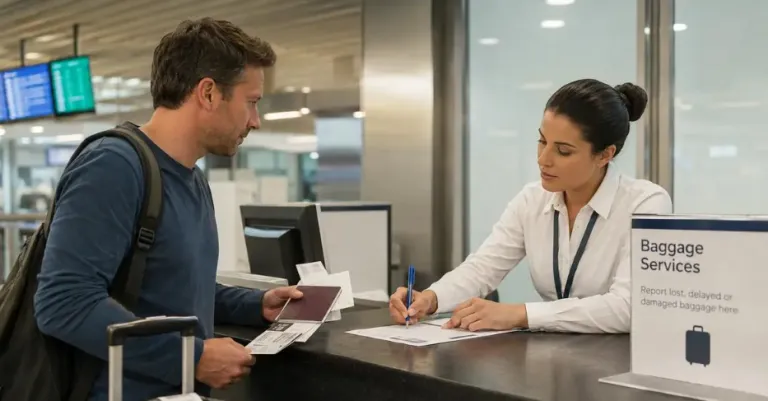
Step 2: Visit the airline's baggage service desk
Look for the airline's baggage assistance counter, usually located near the baggage claim area.
Inform the staff that your checked baggage has not arrived and provide:
Your boarding pass.
Your baggage identification tag.
Your passport or identification.
Your flight number.
Your final destination.
A description of your suitcase.
Step 3: File a Property Irregularity Report (PIR)
This is one of the most important steps.
A Property Irregularity Report, commonly called a PIR, officially records that your baggage has gone missing or arrived damaged.
The airline will generally provide a reference number that you can use to track your luggage.
Do not leave the airport without obtaining a report reference or written confirmation of your complaint.
Keep a photograph or screenshot of the report.
Step 4: Request baggage tracking information
Ask the airline how you can monitor your suitcase's location.
Many airlines use the WorldTracer baggage-tracing system or their own tracking platforms.
You may be able to check whether your luggage has been located, transferred to another airport or scheduled for delivery.
If you use an AirTag or another compatible luggage tracker, share its location information with the airline. Remember that a tracker can help identify a bag's approximate location but does not replace the official baggage claim.
Step 5: Ask about delivery and essential expenses
If your luggage is delayed, ask the airline whether it will deliver your suitcase to your hotel, residence or another agreed address.
Also ask about reimbursement for essential purchases such as:
Basic toiletries.
Essential clothing and underwear.
Necessary medication, where applicable.
Laundry expenses if the delay continues.
Keep every receipt. Reimbursement depends on the applicable rules, airline policy and whether the expenses are considered reasonable.
3. Does the Procedure Change Depending on Which Country You Are In?
Yes. While the basic process of reporting missing baggage is broadly similar worldwide, passenger rights, compensation limits and complaint procedures can differ.
One important distinction: international baggage claims are often governed by the Montreal Convention 1999, an international treaty that establishes airline liability for baggage that is lost, delayed or damaged during international carriage between countries where the Convention applies.
The Convention provides a common framework, but it does not mean every country has identical domestic baggage rules.
Here is how the situation differs across some popular destinations.
A. United States
United States
The United States has specific Department of Transportation (DOT) rules governing baggage complaints and airline responsibilities.
If your checked suitcase does not arrive:
Report the missing baggage to your airline immediately.
Obtain a written baggage report and reference number.
Ask for reimbursement of reasonable, necessary and verifiable expenses caused by the delay.
Keep receipts for all purchases.
Follow up with the airline until the bag is returned or officially declared lost.
An important difference: US domestic flights have a separate baggage liability limit. For domestic journeys, the maximum liability airlines may set for lost, damaged or delayed baggage is currently $4,700 per passenger.
For international journeys covered by the Montreal Convention, the maximum is 1,519 Special Drawing Rights (SDRs) per passenger.
The US DOT also has specific baggage-fee refund rules for significantly delayed baggage. For international flights to or from the US, the thresholds are generally 15 hours for flights of 12 hours or less and 30 hours for longer flights, subject to applicable exceptions.
Official resource: US Department of Transportation - Lost, Delayed or Damaged Baggage.
B. European Union
European Union
Travelling through Europe? Passengers have protections under the Montreal Convention and relevant European aviation legislation.
If your baggage does not arrive:
Report the issue to the airline before leaving the airport.
Obtain a Property Irregularity Report.
Request delivery of your luggage once it is located.
Keep receipts for essential purchases.
Important deadlines:
Situation | Complaint deadline |
Delayed baggage | Within 21 days of receiving it |
Damaged baggage | Within 7 days of receiving it |
Baggage missing for 21 days | Can generally be treated as lost under the Montreal Convention |
The Montreal Convention's baggage liability limit is 1,519 SDRs per passenger, subject to its conditions and exceptions.
If your suitcase is still missing after 21 days, you can pursue a claim for its loss rather than treating it as merely delayed.
Official resource: French Government - Lost, Delayed or Damaged Baggage.
C. United Kingdom
United Kingdom
The UK follows similar baggage-claim principles, with the Montreal Convention forming the basis of international baggage liability.
If your luggage goes missing:
Report it immediately at the airline's baggage desk.
Obtain the baggage report reference.
Keep receipts for essential purchases.
Submit your written claim within the prescribed deadline.
The UK government's passenger travel guidance states that:
Delayed baggage claims should be submitted within 21 days of the baggage being returned.
Damaged baggage claims should be submitted within 7 days of receipt.
Baggage not returned after 21 days can be treated as lost under the applicable Convention framework.
The UK government also explains that airlines may reimburse reasonable essential purchases while baggage is delayed, subject to the applicable conditions.
Official resource: UK Government - Air Passenger Travel Guide.
D. India
India
For Indian travellers, there is an important distinction between domestic and international journeys.
India's Ministry of Civil Aviation Passenger Charter outlines different liability limits for domestic and international baggage carriage.
Type of journey | Published liability limit |
Domestic carriage | ₹20,000 per passenger |
International carriage | 1,131 SDR per passenger |
These figures are from the published Indian Passenger Charter. The applicable international treaty, airline conditions and current legal provisions should be checked before making a claim.
If you are flying internationally from India and your luggage goes missing:
Report the issue to the airline's baggage counter.
Obtain a PIR and baggage tracing reference.
Keep your boarding pass and baggage tag.
Submit a written complaint to the airline.
Keep receipts for essential purchases.
Escalate unresolved complaints through the airline's grievance process and appropriate aviation consumer channels.
For example, Air India allows passengers to track delayed baggage through its baggage support system. It generally categorises baggage as lost if it cannot be traced for 21 days after the PIR is filed.
An important point for Indian travellers: Do not assume that the domestic compensation limit applies to an international ticket. The applicable international carriage rules may be different.
Official resources: Ministry of Civil Aviation - Passenger Charter and Air India - Lost or Damaged Baggage.
E. Canada
Canada
Canada also follows the Montreal Convention for international baggage claims.
For international journeys, passengers generally need to:
Report delayed baggage immediately.
File a written claim within 21 days of receiving delayed baggage.
Report damaged baggage within 7 days of receiving it.
Retain receipts for expenses and evidence of the value of lost belongings.
For baggage that is not returned within 21 days, passengers can pursue a lost-baggage claim.
Canada's Air Passenger Protection guidance confirms the current international baggage liability limit of 1,519 SDRs per passenger for journeys subject to the updated limit.
Domestic Canadian flights can have different rules under the airline's tariff.
Official resource: Canadian Transportation Agency - Baggage Compensation.
4. What If Your Luggage Goes Missing During a Connecting Flight?
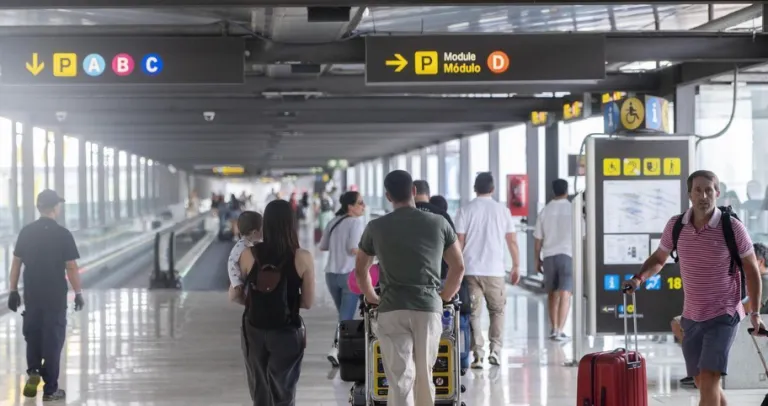
This is one of the most common problems with international travel.
Imagine flying from Bengaluru to London with a connection in Dubai. You successfully board both flights, reach London and discover that your suitcase never made it onto the connecting aircraft.
What happens next?
The answer depends on your ticket, baggage arrangements and the airlines involved.
Scenario 1: Both flights are on one booking
If your entire journey is on a single booking, report the missing bag to the airline at your final destination. Provide your baggage tag and the complete itinerary.
The airline can investigate where the bag was last scanned and coordinate with the other carrier if necessary.
Scenario 2: You booked separate tickets
This can become more complicated.
If you booked Bengaluru-Dubai and Dubai-London separately, you may have to collect your luggage in Dubai, clear the relevant formalities and check it in again.
If the first airline delivered your bag to Dubai but you failed to collect and re-check it, responsibility for the delay may be different.
Always check baggage transfer arrangements before booking separate tickets.
Scenario 3: You change airlines during transit
When different airlines operate different sections of your journey, identify which airline handled the last flight and which carrier accepted the baggage under the relevant booking.
For international journeys covered by the Montreal Convention, liability can extend to the contracting carrier and the carrier that actually performed the relevant carriage, depending on the circumstances.
Do not assume that the airline whose logo appears on your first boarding pass is automatically the only airline responsible.
My advice: Avoid very short international connections if you are checking in multiple bags. A little extra transit time can make a big difference.
5. How Much Compensation Can You Get for Lost Luggage?
This is probably the question every traveller wants answered.
If your luggage is permanently lost, you may be entitled to compensation for the value of your belongings, subject to the applicable international convention, national law and airline conditions.
For international flights covered by the Montreal Convention, the current liability limit is 1,519 SDRs per passenger (effective December 28, 2024).
But what exactly is an SDR?
Special Drawing Rights are an international reserve asset created by the International Monetary Fund. Their value is calculated using a basket of major currencies, so the equivalent amount in dollars, euros or rupees changes with exchange rates.
A few important things to understand:
The compensation limit is per passenger, not per suitcase.
It is a maximum liability limit, not an automatic payout.
You generally need to establish the value of your losses.
Airlines may consider depreciation when calculating compensation.
You may be entitled to reimbursement for reasonable expenses caused by delayed baggage.
Additional protection may be available if you made a special declaration of value at check-in and paid the applicable fee.
If you are travelling with expensive equipment, jewellery or other valuable belongings, check the airline's conditions and consider separate insurance.
6. What If Your Luggage Is Found but Your Holiday Is Almost Over?

Imagine travelling to Italy for a five-day holiday. Your suitcase goes missing on the first day and finally arrives on the fourth.
Technically, your luggage has been recovered. But you have already spent money purchasing clothes, toiletries and other essentials.
Can you claim that money back?
Potentially, yes.
Under the Montreal Convention, passengers may claim reasonable and documented losses caused by baggage delays, subject to the applicable liability limit and legal conditions.
However, there are a few things to remember:
Buy only what you genuinely need.
Keep original receipts.
Avoid expensive luxury purchases.
Inform the airline if the delay continues.
Submit your reimbursement request in writing.
For example, purchasing basic clothing and toiletries is easier to justify than buying an expensive designer wardrobe because your suitcase has not arrived.
The airline may also have its own reimbursement process, so ask about its policy before making large purchases.
7. What If the Airline Refuses to Help?
Unfortunately, getting a baggage report does not always mean getting an immediate solution.
If the airline is not responding, refuses to reimburse reasonable expenses or rejects your claim without a clear explanation, consider escalating the matter.
Country | Where to escalate |
USA | Department of Transportation (DOT) |
EU | Relevant national enforcement body or consumer dispute mechanism |
UK | Civil Aviation Authority (CAA) and applicable approved dispute resolution scheme |
India | Airline grievance channel, AirSewa and relevant consumer grievance mechanisms |
Canada | Canadian Transportation Agency (CTA) |
Before escalating, collect:
Your PIR reference.
Boarding passes and baggage tags.
Airline correspondence.
Receipts for emergency purchases.
An itemised list of missing belongings.
Purchase invoices or other proof of ownership.
Remember that the airline's internal complaint process and the relevant national regulator may have different procedures.
8. How to Prevent Your Luggage from Getting Lost in the First Place
You cannot completely eliminate the possibility of baggage mishandling, but a few precautions can reduce the inconvenience.
1. Photograph your suitcase before check-in
Take pictures of the exterior, colour, brand and any distinguishing features. This makes it easier to identify your bag.
2. Attach a proper luggage tag
Include your name, email address and contact number. Consider adding a destination address rather than displaying your full home address.
3. Keep your baggage receipt
That small sticker handed over at check-in can become extremely important when filing a missing baggage report.
4. Use a luggage tracker
Devices such as AirTags and compatible Bluetooth trackers can help you identify your suitcase's approximate location.
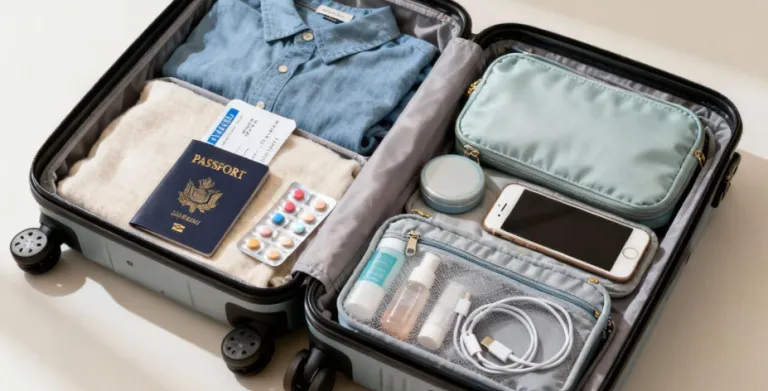
5. Pack essentials in your cabin bag
Always keep the following with you:
Passport and travel documents.
Prescription medication.
Cash and bank cards.
Electronic devices.
One change of clothes.
Essential toiletries.
Important valuables.
6. Avoid unnecessarily tight connections
Every additional flight transfer creates another opportunity for baggage mishandling. When possible, choose direct flights or allow sufficient connection time.
7. Consider travel insurance
Check whether your policy covers delayed baggage, permanently lost luggage, emergency purchases and personal belongings. Pay attention to exclusions, reporting requirements and claim limits.
Final Thoughts
Losing luggage in a foreign country can turn an exciting holiday into an exhausting experience. But the most important thing is to act quickly, document everything and understand your passenger rights.
Remember that a suitcase missing from the carousel is not automatically a permanently lost suitcase. In many cases, it may have been left behind during a transfer, sent to the wrong airport or delayed because of baggage-handling issues.
Also, do not assume that the rules in one country automatically apply everywhere. The Montreal Convention provides an important international framework, but domestic regulations, airline policies and complaint procedures can differ.
So, before your next international adventure, photograph your suitcase, save your baggage tag and keep your essentials in your cabin bag.
Because the last thing you want after a 12-hour flight is to begin your holiday shopping for things you already own!
Published at
About Author

Atihsin
Subscribe our Newsletter
Get our weekly tips and travel news!
Related Posts
Travel Guide to Dubai from India 2023
Welcome to the enchanting realm of Dubai, where ancient traditions seamlessly blend with futuristic marvels. In this comprehensive travel guide, we embark on a captivating journey from India to the dazzling desert metropolis of Dubai. From informatio...
What to Expect When Travelling to London: Expectations vs Reality
Given the increasing migration inflow to London every year, the defining features of London as a place of endless job opportunities, stunning architecture, and history, as well as the alluring Brit...
What to Expect When Travelling to Nepal: Expectations vs. Reality
What comes to your mind when you first think about Nepal? Majestic views of the sunrise against the snow capped peaks of the Himalayan mountains, rows of colorful prayer flags fluttering in the cri...
What to Expect When Travelling to Santorini: Expectations vs Reality
Santorini has long been a firm favourite on everyone’s bucket list. Even though the very essence of “The Greek Islands” does look stunning in travel magazines and social media, is...
Travel Guide to Vietnam from India 2023
Vietnam, with its captivating blend of ancient traditions and modern allure, beckons Indian travelers with open arms. This Southeast Asian gem boasts a rich cultural tapestry, breathtaking landscapes, and a vibrant street food scene that will leave y...
Latest Posts
10 Tourist Scams Around the World and How to Avoid Them
Planning an international holiday? Beware of fake taxi drivers, free bracelet tricks, fake police officers and fraudulent travel bookings. Here are 10 common tourist scams around the world and simple ways to protect yourself.
Planning a Thailand trip this November? Chiang Mai Airport has cancelled 108 flights and rescheduled 80 ahead of the Yi Peng Lantern Festival. Here's everything travellers need to know about flight restrictions, festival dates and airport travel precautio
Finland Offers Free Trips to 16 Singles in 2027: How Indians Can Apply
Forget dating apps! Finland is inviting 16 international singles on a four-day, all-expenses-paid culinary trip in February 2027. Here's how Indian travellers can apply for the Finnish Dinner Date.
India Visa Rules 2027 – Proposed Changes Every International Traveller Should Know
India is planning major visa reforms for 2027, with fewer visa categories and shorter application forms. Explore the proposed changes and current requirements.
8 Best Christmas Markets Around the World to Visit in 2026
From Germany's traditional Christmas fairs to Singapore's spectacular festive lights, discover 8 Christmas markets around the world that promise unforgettable December experiences.