
India Launches National Digital Tourism Stack: What Travellers Need to Know
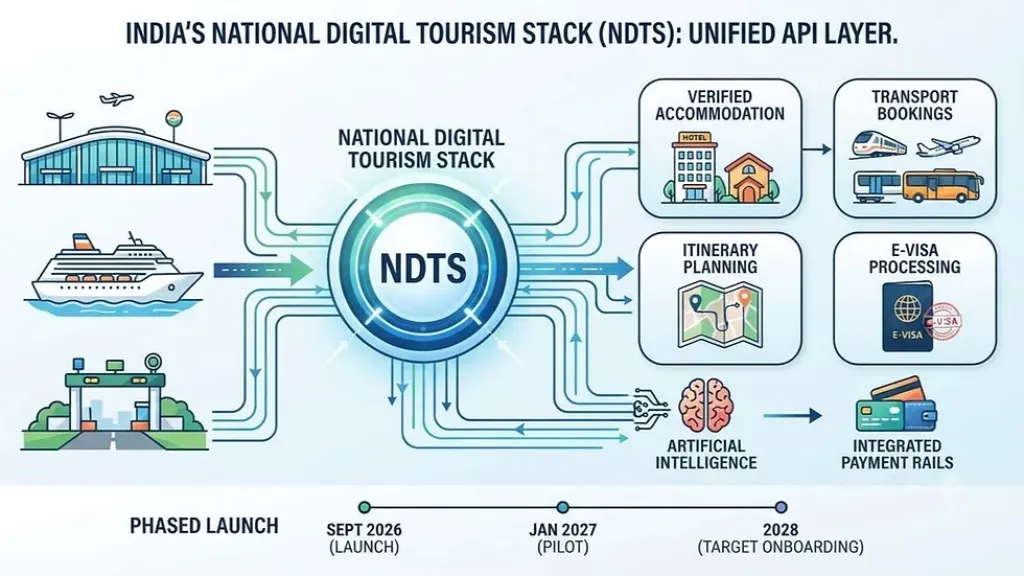
India has launched a new National Digital Tourism Stack (NDTS) aimed at making travel planning, discovering destinations and booking tourism experiences more convenient through a shared digital infrastructure.
The initiative was launched by the Ministry of Tourism in collaboration with the Open Network for Digital Commerce (ONDC) around World Tourism Day 2026. It is designed to bring tourism providers, destinations and travellers into a more connected digital ecosystem.
What Is the National Digital Tourism Stack?
The National Digital Tourism Stack is an open digital public infrastructure for India's tourism sector.
The initiative aims to make tourism offerings easier to discover, access, trust and book. It is being developed with ONDC and support from the International Centre for DPI Innovation and Advancement (ICDIA).
The government has set a target of bringing 23,000 tourism experiences and homestays onto the digital ecosystem and making them discoverable, trustworthy and bookable by the end of 2028.
How Will the New Digital Tourism System Work?
One of the key objectives is to reduce the fragmentation travellers currently face while planning trips.
A traveller may need separate platforms to book flights, hotels, taxis, activities and other experiences. The new system is intended to connect these different elements through shared digital infrastructure.
Tourism Secretary Bhuvnesh Kumar described the long-term vision as “One ticket, One pass”, bringing different parts of a journey together.
Also Read : Best Places to Visit in India in 2026: Top Destinations for Every Traveler
AI Will Play a Major Role
Artificial intelligence is expected to be an important part of the National Digital Tourism Stack.
The Ministry of Tourism has said that AI will form the front end of the initiative, potentially helping travellers discover destinations and tourism services in a more personalised way.
This could eventually make it easier for travellers to search for destinations, accommodation, activities and local experiences based on their interests.
For example, instead of searching separately for hotels, attractions and activities, future digital travel services could potentially bring relevant options together in one journey.
Smaller Tourism Businesses Could Benefit
The initiative is not only focused on large hotels and established tourism companies.
A major objective is to improve the digital visibility of smaller tourism businesses, local entrepreneurs, homestays and lesser-known destinations.
This could help local tourism providers reach travellers through participating digital platforms without having to build their own large booking infrastructure.
The government also wants tourism growth to reach local communities and support entrepreneurs, women and young people working in the sector.
What Could This Mean for Travellers?
For tourists, the National Digital Tourism Stack could eventually make several parts of trip planning easier.
Potential benefits include:
Easier destination discovery
More visibility for lesser-known places
Better access to local experiences
Verified tourism providers
Integrated digital payments
Ratings and reviews
Grievance-redressal mechanisms
More connected travel services
Greater use of AI for travel planning
The system is being developed in phases, so not every feature will be available immediately.
More Lesser-Known Destinations Could Get Attention
Alongside the National Digital Tourism Stack, the Ministry of Tourism has launched Dekho Apna Desh Campaign 2.0, focused on promoting alternative and lesser-known destinations.
The objective is to distribute tourism demand beyond India's most popular destinations and encourage travellers to explore a wider range of places.
For travellers, this could mean greater visibility for destinations outside the usual tourist circuits.
What Is Dekho Apna Desh 2.0?
Dekho Apna Desh 2.0 is part of the government's efforts to promote alternative destinations and redistribute tourist footfall.
Instead of concentrating visitors in a small number of heavily visited destinations, the initiative aims to encourage travel to places that have tourism potential but receive comparatively less attention.
This could also create opportunities for local communities involved in accommodation, food, transport, handicrafts and tourism experiences.
India's Tourism Sector Is Becoming More Digital
The new initiative comes as India's tourism sector increasingly adopts digital services.
According to the Ministry of Tourism, India recorded 428.55 crore domestic tourist visits in 2025, while foreign tourist visits reached 2.53 crore. Tourism contributed 5.22% of India's GDP and supported 8.46 crore jobs in 2023–24, according to government data.
Digital platforms are becoming increasingly important in how travellers discover destinations, compare services and make bookings.
What About the Incredible India Platform?
The National Digital Tourism Stack will complement existing government digital tourism initiatives.
The Incredible India Digital Platform already provides destination information and travel-related services, including information about attractions, festivals and experiences. It also connects users with booking services and other tourism stakeholders.
The new digital stack is intended to create a broader interoperable ecosystem connecting tourism providers and platforms.
When Will Travellers See the Full Benefits?
The National Digital Tourism Stack is being implemented in phases.
The government's target is to bring 23,000 tourism experiences and homestays into the ecosystem by the end of 2028.
This means travellers should not expect every tourism service to become available through one system immediately.
The platform will expand as more tourism providers, states, Union Territories and industry participants join the ecosystem.
What Does This Mean for Future Travel in India?
If the project develops as planned, travellers could eventually have a more connected digital journey — from discovering a destination to booking accommodation, transport and activities.
It could also make it easier for travellers to discover local experiences and destinations beyond India's traditional tourist hotspots.
For small tourism businesses, the system could provide greater digital visibility and access to travellers through participating platforms.
Final Takeaway
India's new National Digital Tourism Stack marks another step towards a more digitally connected tourism ecosystem.
Developed by the Ministry of Tourism with ONDC, the initiative aims to make tourism experiences more discoverable, trustworthy, accessible and bookable, while supporting smaller businesses and lesser-known destinations.
With a target of 23,000 tourism experiences and homestays by 2028, the project could gradually change how travellers discover and plan trips across India.
For travellers, the biggest change may come gradually as more providers join the system and AI-powered travel services become integrated into the digital tourism ecosystem.
Published at
About Author

Subscribe our Newsletter
Get our weekly tips and travel news!
Related Posts
West Bengal: Tagore's Residence Santiniketan Achieves UNESCO World Heritage Status
Santiniketan, a town in West Bengal's Birbhum region where Nobel laureate Rabindranath Tagore spent much of his life, has been added to the UNESCO World Heritage List.
UK Visitor Visa Fee Hiked: What's the New fee?
Planning to visit the United Kingdoms? Watchout for this Hike in Visa Charges. A UK tourist visa for less than six months will cost an additional £1,543 (£ 15), while UK student visas will cost an additional £13,070 (£127) for visitors from all over the w
India Issues Caution for Travel to Canada - Visa suspended
The advisory, issued by the Ministry of External Affairs (MEA), comes amid a diplomatic row between the two countries over allegations that the Indian government may be linked to the extra-judicial killing of a Sikh separatist in Canada.
First snowfall of the season in Gulmarg
As the chilly winds of winter start to sweep across the northern regions of India, Gulmarg, the crown jewel of Jammu and Kashmir, has once again transformed into a breathtaking winter wonderland. Nature's magic was on full display as Gulmarg recently...
Biswanath Ghat: Best tourism village of India 2023
In an exciting announcement, Biswanath Ghat in Assam has been crowned as India's "Best Tourism Village of 2023" by the Ministry of Tourism. This well-deserved recognition is a testament to the village's unique blend of cultural heritage, natural beau...
Latest Posts
Bangkok Floods 2026: Thai Airways Cancels Flights as Airport Disruptions Continue
Bangkok floods are disrupting flights, baggage handling and road transport. Here's the latest Thai Airways, airport and travel update for tourists.
Bangkok Floods 2026: What Indian Travellers Need to Know Before Visiting
Bangkok is dealing with widespread flooding, but its major airports remain operational. Here's what Indian travellers should know before visiting.
Philippine Airlines to Launch Delhi and Mumbai Flights in December 2026
Philippine Airlines plans to launch nonstop Manila–Delhi and Manila–Mumbai flights in December 2026, giving travellers new direct India-Philippines connections.
India–Vietnam Flights to Double: New Aviation Deal Brings More Travel Options
India and Vietnam have agreed to more than double weekly air capacity to over 16,000 seats, opening the door to more direct flight options for Indian travellers.
Delhi Airport Beats Dubai in Global Connectivity: What Indian Travellers Should Know
Delhi Airport has climbed to 28th in OAG's 2026 global connectivity ranking, moving ahead of Dubai. Here's what Indian travellers should know.