
Vande Bharat Sleeper Train Launch January 2026: Route, Fare, Features & Booking Guide

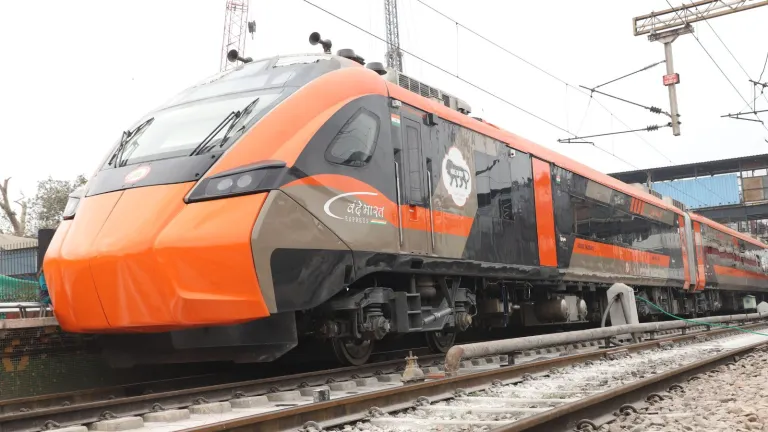
In a landmark moment for Indian Railways, the country's first-ever Vande Bharat Sleeper Train will begin operations in January 2026, marking a transformative shift in overnight rail travel. Prime Minister Narendra Modi is expected to flag off this historic service between January 16-20, 2026, introducing a semi-high-speed sleeper train that combines the comfort of premium overnight travel with the efficiency of modern rail technology.
For travelers seeking alternatives to expensive flights or slow conventional trains, the Vande Bharat Sleeper represents a sweet spot—faster than traditional railways, more comfortable than budget travel, and significantly more affordable than air travel. Here's everything you need to know about India's newest rail innovation.
Vande Bharat Sleeper Train Route: Connecting East and Northeast India
Inaugural Route: Guwahati to Kolkata
The first Vande Bharat Sleeper Train will operate on the strategically important Guwahati-Kolkata corridor, running between Kamakhya Station (Guwahati, Assam) and Howrah Junction (Kolkata, West Bengal). This 966-kilometer route directly connects Eastern India with the Northeast region, an area that has long needed improved rail connectivity.
According to Northeast Frontier Railway's proposed schedule submitted to the Railway Board:
Departure from Kamakhya (Guwahati): 7:00 PM (19:00)
Arrival at Howrah (Kolkata): 9:30 AM (09:30) next morning
Journey Duration: 14 hours 30 minutes
Average Speed: 66.62 km/h
Maximum Speed Capacity: 180 km/h
Key Stops Along the Route
The Vande Bharat Sleeper will make strategic halts at important stations, improving connectivity across multiple districts in Assam and West Bengal:
In Assam:
Rangiya (RNY)
Barpeta Road (BPRD)
New Bongaigaon (NBQ)
Kokrajhar (KOJ)
In West Bengal:
New Cooch Behar (NCB)
New Jalpaiguri (NJP)
KishanGanj (KNE)
Malda Town (MLDT) - 10-minute halt at 4:50 AM (Down journey) and 10:30 PM (Up journey)
This network of halts benefits districts including Kamrup Metropolitan, Bongaigaon, Coochbehar, Jalpaiguri, Maldah, Murshidabad, Purba Bardhaman, Hooghly, and Howrah.
Why This Route Matters
The Guwahati-Kolkata corridor is one of India's busiest rail routes, serving business travelers, families, students, and tourists connecting the Northeast with mainland India. Previously, passengers faced limited options:
Conventional trains: Taking 18-24 hours with basic amenities
Flights: Expensive (typically Rs 5,000-15,000) with limited frequency
Bus travel: Long, uncomfortable journeys
The Vande Bharat Sleeper bridges this gap, cutting travel time by 4-6 hours compared to regular trains while offering premium comfort at reasonable prices—creating genuine competition for air travel on this sector.
Vande Bharat Sleeper Train Fare: Affordable Premium Travel
Railway Minister Ashwini Vaishnaw announced indicative fares for the Vande Bharat Sleeper, positioning it as an affordable premium option:
Ticket Prices (Including Meals)
AC 3-Tier (3AC): Approximately Rs 2,300
AC 2-Tier (2AC): Around Rs 3,000
AC First Class (1AC): About Rs 3,600
These fares include meals, making the Vande Bharat Sleeper Train a competitive alternative to air travel. For comparison, last-minute flight tickets on the Guwahati-Kolkata route typically range from Rs 4,500 to Rs 12,000, while conventional AC trains charge Rs 1,800-2,500 but take significantly longer.
Cost-Benefit Analysis: Vande Bharat Sleeper vs Other Options
Compared to Flights:
Save Rs 1,500-8,000 on average
No airport transfer costs or time
No additional baggage fees
Meals included in fare
More convenient city-center to city-center travel
Compared to Conventional Trains:
Additional Rs 300-800 investment
Save 4-6 hours of journey time
Significantly improved comfort and amenities
Quieter, smoother ride
Modern safety features
Compared to Bus Travel:
Premium experience at comparable or slightly higher prices
Much faster journey times
Superior comfort and safety
Onboard facilities and services
For most travelers, the Vande Bharat Sleeper offers exceptional value—premium service at mid-range prices, making overnight rail travel genuinely appealing rather than merely economical.
Vande Bharat Sleeper Train Features: Premium Comfort Meets Modern Technology
Coach Configuration and Capacity
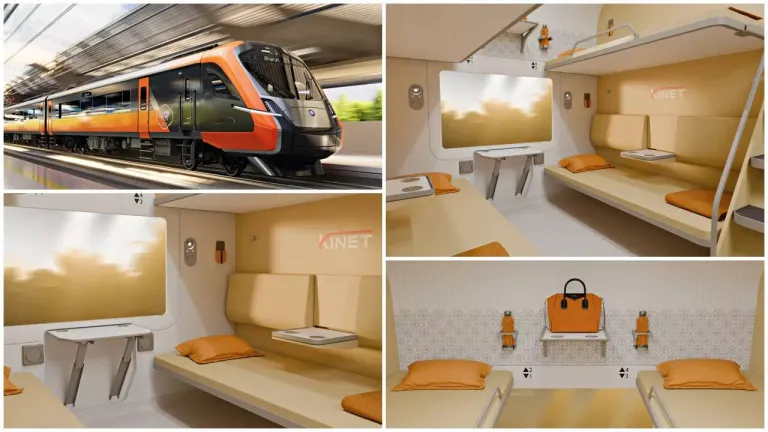
Each Vande Bharat Sleeper train consists of 16 fully air-conditioned coaches with a total passenger capacity of 823:
11 AC Three-Tier Coaches: 611 berths
4 AC Two-Tier Coaches: 188 berths
1 AC First Class Coach: 24 berths
This composition caters to diverse traveler preferences while maintaining premium standards across all classes—a significant upgrade from conventional trains where AC tiers often feel cramped and poorly maintained.
Passenger Comfort Features
The Vande Bharat Sleeper Train has been specifically designed for long-distance overnight travel, incorporating features that address common complaints about Indian Railways' existing sleeper services:
Enhanced Berth Design:
Ergonomically designed sleeping berths
Improved cushioning with better support for long-duration rest
Wider berths compared to conventional trains
Thoughtful layout maximizing personal space
Noise and Vibration Reduction:
Advanced suspension systems for smoother rides
Reduced mechanical noise for better sleep quality
Vibration dampening technology
Quieter operations even at high speeds
Modern Interiors:
Spacious coach interiors with contemporary design
Modern LED lighting with adjustable brightness
Climate-controlled environment throughout
Improved ventilation systems
Connectivity and Movement:
Automatic doors with vestibules between coaches
Easier movement throughout the train
Smooth boarding and alighting
Better accessibility features
Hygiene and Cleanliness:
Disinfectant-based cleaning technology
Modern bio-toilets with improved maintenance
Regular cleaning protocols
Touchless fixtures where possible
Safety and Security Features
Safety takes priority in the Vande Bharat Sleeper Train, incorporating technologies beyond what conventional trains offer:
Kavach Anti-Collision System: The train features Kavach, India's indigenous automatic train protection system that prevents collisions through real-time monitoring and automatic braking if drivers fail to respond to signals.
Emergency Communication:
Emergency talk-back system for passenger-crew communication
Direct emergency contact facilities
Enhanced security monitoring
Driver Cab Technology:
Advanced controls with modern displays
Improved safety systems and monitoring
Better visibility and operational efficiency
Structural Safety:
Armor protection system for enhanced security
Fire detection and suppression systems
Emergency evacuation protocols
Crashworthy design elements
Onboard Amenities
While detailed amenity information awaits official announcement, based on existing Vande Bharat chair-car trains and Railway Ministry statements, passengers can expect:
Food Service: Meals included in fare, with regional cuisine options reflecting state-wise menus Indian Railways has introduced
Power Outlets: Charging points at berths for phones and devices
Reading Lights: Individual lights for each berth
Luggage Space: Improved storage compared to conventional trains
Modern Toilets: Bio-toilets with better maintenance standards
Information Systems: Digital displays for station information and journey details
Vande Bharat Sleeper Train Booking: When and How to Reserve Your Seat
Booking Timeline
While exact booking opening dates haven't been officially announced, Indian Railways typically opens bookings 120 days (approximately 4 months) in advance for premium trains. Based on the expected mid-January 2026 launch, bookings could open as early as mid-September 2025.
However, for the inaugural service flagged off by the Prime Minister, bookings will likely open shortly after the official launch date is confirmed—potentially just 15-30 days before the first commercial run.
Potential Future Routes
While official route announcements are pending, industry sources and railway officials have indicated several high-demand corridors under consideration:
Southern Corridors:
Bangalore to Kanyakumari via Chennai
Mumbai to Bangalore
Chennai to Trivandrum
Northern Corridors:
Delhi to Mumbai
Delhi to Kolkata
Delhi to Guwahati
East-West Connectivity:
Mumbai to Kolkata
Pune to Kolkata
Ahmedabad to Kolkata
Tourist Circuits:
Delhi to Varanasi
Mumbai to Goa
Chennai to Rameswaram
The selection criteria focus on routes between 1,200-1,500 kilometers—distances where overnight sleeper trains offer maximum advantage over both shorter daytime trains and longer air journeys.
Production Scale-Up
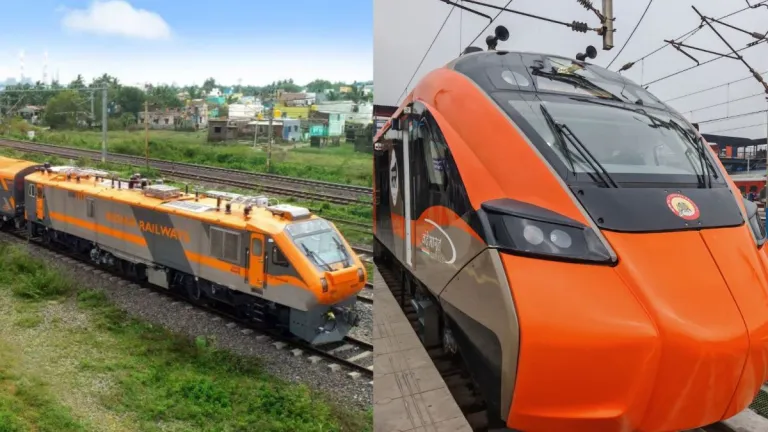
Close to 200 Vande Bharat trains (including both chair-car and sleeper versions) are at various manufacturing stages, indicating a long-term commitment to transforming India's rail infrastructure. The partnership between Indian Railways, BEML (Bharat Earth Movers Limited), and ICF (Integrated Coach Factory) Chennai ensures domestic production capacity meets expansion targets.
Impact on Tourism and Regional Development
The Vande Bharat Sleeper Train launch carries implications beyond rail modernization:
Boosting Northeast Tourism
Northeast India remains India's least-visited region despite extraordinary natural beauty and cultural richness. Better rail connectivity from Kolkata—a major transit hub—makes destinations like Kaziranga National Park, Cherrapunji, Tawang, and Majuli Island more accessible to domestic and international tourists.
The 4-6 hour time saving means travelers can reach Guwahati overnight and start exploring immediately, making even weekend trips to the Northeast feasible from Kolkata and beyond.
Economic Development
Improved connectivity stimulates economic activity:
Enhanced trade links between eastern and northeastern regions
Easier business travel encourages investment
Tourism revenue increases for local communities
Employment generation in hospitality and services
Reduced transportation costs for goods movement
Competitive Pressure on Airlines
Airlines operating the Guwahati-Kolkata sector—including IndiGo, SpiceJet, Air India, and Vistara—will face increased competition. This could lead to:
More competitive airfares
Improved flight schedules
Better service standards
Overall benefit to travelers through enhanced choices
Environmental Benefits
Trains are significantly more energy-efficient than planes per passenger-kilometer. Electric trains like Vande Bharat generate less carbon emissions compared to flights:
Approximately 10-15 kg CO2 per passenger (train) vs 40-50 kg CO2 per passenger (flight)
Reduced air traffic congestion
Lower overall environmental impact of Northeast-Eastern India connectivity
Challenges and Realistic Expectations
While the Vande Bharat Sleeper represents a significant advancement, realistic expectations matter:
Infrastructure Limitations
The train's 180 km/h capability is constrained by existing track conditions. On the Guwahati-Kolkata route, average speeds will be around 66 km/h initially, though still faster than conventional trains. Full speed potential requires ongoing track upgrades—a multi-year process.
High Initial Demand
The first few months will see extremely high demand, making ticket bookings competitive. Waitlists and fully-booked status should be expected, especially during:
Festival seasons (Durga Puja, Diwali, Bihu)
Summer vacation periods (April-June)
Winter holiday season (December-January)
Long weekends
Limited Initial Frequency
With only two trains initially operational, frequency won't match conventional trains or flights immediately. The six-day-a-week schedule means one day without service, requiring flexibility in travel planning.
Fare Premium vs Conventional Trains
While cheaper than flights, Vande Bharat Sleeper fares are 15-30% higher than conventional AC trains. Budget-conscious travelers might still prefer regular trains despite longer journey times and basic amenities.
Operational Teething Issues
New services typically face initial operational challenges:
Punctuality stabilizes over first few months
Service protocols refine based on passenger feedback
Minor technical issues get resolved
Crew training reaches optimal levels
These are normal for any major railway launch and shouldn't deter travelers, but setting realistic expectations helps.
How Vande Bharat Sleeper Fits Into India's Rail Modernization
The sleeper train launch is part of India's broader railway transformation under the Amrit Bharat Station Scheme and National Rail Plan:
Parallel Developments
Vande Bharat Chair Car Expansion: Currently 82 Vande Bharat Express services operate across India, with plans to reach 400 trains by 2025-26. These daytime services complement sleeper trains for comprehensive coverage.
Station Modernization: Major stations including Guwahati, Howrah, New Delhi, Mumbai, and Bangalore are undergoing redevelopment with world-class facilities matching the quality of Vande Bharat trains.
High-Speed Rail Projects: The Mumbai-Ahmedabad bullet train and planned Delhi-Varanasi high-speed corridor represent the next tier of rail development, with Vande Bharat trains serving as intermediate-speed solutions.
Digital Infrastructure: Nationwide WiFi, digital ticketing, real-time tracking, and AI-based passenger information systems are being rolled out across Indian Railways.
Safety Enhancements: Kavach anti-collision system deployment across high-density routes and elimination of unmanned level crossings improve overall railway safety.
India's Vision: Multi-Tier Rail Network
Indian Railways is creating a differentiated service ladder:
High-Speed (250+ km/h): Bullet trains on select corridors
Semi-High-Speed (160-180 km/h): Vande Bharat trains (chair car and sleeper)
Express (110-130 km/h): Shatabdi, Rajdhani, Duronto services
Mail/Express (80-100 km/h): Regular long-distance services
Passenger (40-60 km/h): Local and regional connectivity
This tiered approach ensures options for every budget and travel need while progressively modernizing infrastructure.
The Bottom Line: Should You Take the Vande Bharat Sleeper Train?
For most travelers on the Guwahati-Kolkata route, the answer is a resounding yes. The Vande Bharat Sleeper Train offers:
✅ Optimal balance of speed, comfort, and affordability
✅ Significant time savings over conventional trains
✅ Better value than last-minute flights
✅ Modern amenities and safety features
✅ Convenient timings for overnight travel
✅ City-center connectivity without airport hassles
✅ Inclusive pricing with meals included
✅ Sustainable travel with lower environmental impact
The main scenarios where alternatives might be preferable:
Ultra-tight schedules requiring absolute fastest travel (flights)
Extremely budget-conscious travel (conventional trains)
Daytime travel preferences (chair-car Vande Bharat or flights)
For the vast majority seeking comfortable, efficient, and reasonably priced overnight travel between Guwahati and Kolkata and soon, other routes the Vande Bharat Sleeper Train represents India's best overnight rail experience.
Final Thoughts:
The Vande Bharat Sleeper Train represents more than just another train, it symbolizes India's railway transformation and commitment to world-class travel infrastructure. For travelers between Guwahati and Kolkata, and soon across many more routes, this service promises to make overnight rail travel not just bearable but genuinely enjoyable.
As India's rail network modernizes, the Vande Bharat Sleeper Train stands as proof that Indians don't have to choose between affordability and quality. You can have both -comfortable berths, fast travel times, modern safety, all at prices that make sense for middle-class India.
Whether you're a business traveler optimizing your schedule, a family planning a holiday in Northeast India, or simply someone who appreciates quality rail travel, the Vande Bharat Sleeper Train deserves a spot on your travel plans for 2026.
Book early, travel comfortably, and experience the future of Indian Railways.
Published at

Subscribe our Newsletter
Get our weekly tips and travel news!
Related Posts
West Bengal: Tagore's Residence Santiniketan Achieves UNESCO World Heritage Status
Santiniketan, a town in West Bengal's Birbhum region where Nobel laureate Rabindranath Tagore spent much of his life, has been added to the UNESCO World Heritage List.
UK Visitor Visa Fee Hiked: What's the New fee?
Planning to visit the United Kingdoms? Watchout for this Hike in Visa Charges. A UK tourist visa for less than six months will cost an additional £1,543 (£ 15), while UK student visas will cost an additional £13,070 (£127) for visitors from all over the w
India Issues Caution for Travel to Canada - Visa suspended
The advisory, issued by the Ministry of External Affairs (MEA), comes amid a diplomatic row between the two countries over allegations that the Indian government may be linked to the extra-judicial killing of a Sikh separatist in Canada.
First snowfall of the season in Gulmarg
As the chilly winds of winter start to sweep across the northern regions of India, Gulmarg, the crown jewel of Jammu and Kashmir, has once again transformed into a breathtaking winter wonderland. Nature's magic was on full display as Gulmarg recently...
Biswanath Ghat: Best tourism village of India 2023
In an exciting announcement, Biswanath Ghat in Assam has been crowned as India's "Best Tourism Village of 2023" by the Ministry of Tourism. This well-deserved recognition is a testament to the village's unique blend of cultural heritage, natural beau...
Latest Posts
Tanzania Introduces Mandatory Travel Insurance for Foreign Visitors in 2026
Planning a trip to Tanzania? A new mandatory travel insurance requirement took effect on 1 October 2026. Here is what international visitors need to know before travelling.
10 Underrated Places to Travel in 2026: Beautiful Destinations Away from the Crowds
Escape the usual tourist hotspots and discover 10 underrated places to travel in 2026, featuring scenic mountain valleys, historic towns, remote islands and peaceful coastal escapes.
Best Emerging Travel Destinations for Indians in 2027: 7 Places to Visit Before They Get Popular
Looking for somewhere new to travel in 2027? Explore seven emerging destinations, including Bishkek, Okinawa, Malvan, Pokhara and Phu Quoc, for your next adventure.
October Getaways: 15 Best Places to Visit in India Before the Winter Rush
October is one of the best months to travel across India, with the monsoon retreating, cooler weather arriving and the country's festive season coming alive.
Austria Visa for Indians: Types and Requirements 2026
Planning a trip to Austria from India? This complete guide covers Austria visa types for Indians, including tourist, visitor, business, student, work and medical visas.