
Indian Railways Charging Rule: Why Your Phone May Stop Charging at Night
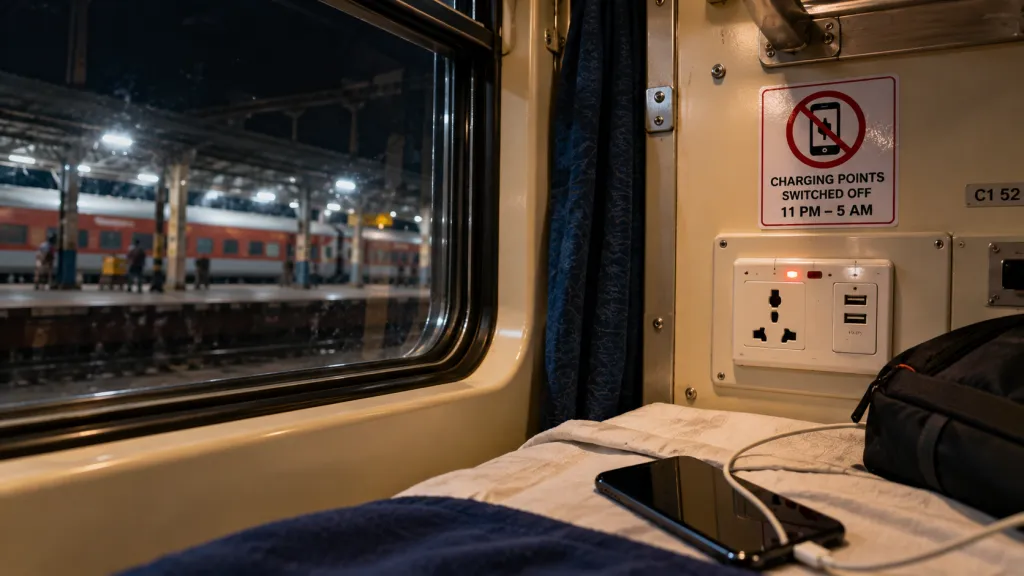
Imagine settling into your train berth after a long day, plugging in your phone, and preparing to wake up to a fully charged battery. Everything seems sorted-until you discover that the charging socket has stopped working.
For passengers travelling overnight, this could become a familiar situation. Indian Railways is tightening the enforcement of restrictions on using electrical charging points during night hours, with charging sockets in trains reported to be switched off between 11 PM and 5 AM.
The move is intended to reduce fire risks associated with electrical equipment and unattended charging in coaches. However, it also raises a practical question for passengers: how do you keep your phone, laptop or other essential device powered during a long journey?
Here is what travellers need to know about the reported rule, the safety concerns behind it, and how to prepare for overnight train journeys without running out of battery.
What Is the New Indian Railways Charging Rule?
According to reports by The Hindu and The Economic Times, Indian Railways is enforcing restrictions that involve switching off train charging points during the overnight period.
The reported timings are:
Charging points switched off: 11 PM
Charging points available again: 5 AM
Duration of restriction: Approximately six hours
The restriction affects passengers who rely on onboard electrical sockets to charge their mobile phones and other personal devices.
The important distinction is that the restriction concerns the availability of charging points during specified hours. It does not mean that passengers are prohibited from carrying mobile phones or that every electrical facility on the train is switched off.
Travellers should also check the latest instructions applicable to their train, as implementation and operational details may vary. The rule should not be interpreted as a blanket ban on carrying or using mobile devices overnight.
Why Is Indian Railways Restricting Overnight Charging?
1. Reducing the risk of electrical fires
Fire safety is a major concern in passenger trains, where people sleep in relatively enclosed spaces and may not immediately notice an electrical fault.
Damaged charging cables, faulty adapters, poor-quality accessories and overloaded electrical connections can increase the risk of overheating or short circuits. A fault occurring while passengers are asleep may take longer to be noticed.
Restricting access to charging points during overnight hours is intended to reduce some of these risks.
2. Preventing unattended charging hazards
Most passengers have a familiar bedtime routine: plug in the phone, set an alarm and fall asleep. But a damaged cable or faulty charger can continue to pose a risk even when nobody is actively using the device.
Switching off charging points during the designated period reduces the opportunity for charging-related electrical incidents during hours when passengers and staff may be less likely to notice a problem immediately.
3. Improving safety in crowded coaches
Sleeper and AC coaches can accommodate many passengers, each carrying electronic devices. In such an environment, even a small electrical incident can cause panic and make evacuation more difficult.
Preventive measures are particularly important because a train is a moving environment with limited space and passengers resting in close quarters.
The objective is not to make overnight travel inconvenient. It is to reduce avoidable risks while keeping passengers and railway property safe.
What Do Experts Say About Switching Off Charging Points?
The reported restriction has also prompted discussion about whether switching off all charging points is the most effective way to improve safety.
Experts cited by ThePrint have suggested alternatives such as appropriate fuses and circuit breakers. These devices can help interrupt electrical supply when certain faults or unsafe conditions occur.
The broader debate is about balancing preventive safety measures with passenger convenience.
A time-based shutdown is a straightforward precaution, but electrical protection systems, regular maintenance and passenger awareness also play important roles. No single measure can eliminate every possible fire hazard.
For passengers, the practical takeaway remains the same: do not depend entirely on a train's charging socket to keep essential devices powered throughout an overnight journey.
How Will the Rule Affect Train Passengers?
The biggest impact will be on travellers who board trains with low battery levels or depend on their phones for navigation, digital tickets, payments and communication.
Here are a few situations in which the restriction may cause inconvenience:
Long-distance travellers: Passengers on overnight journeys may have to plan charging around the restricted hours.
Solo travellers: A charged phone can be particularly important for contacting family, checking journey details and arranging transport on arrival.
Passengers using digital tickets: Those who rely on their phones for ticket details should keep their information accessible before boarding.
People travelling for work: Passengers carrying laptops or tablets may need to finish charging before the overnight shutdown.
Families travelling with children: Keeping devices ready for communication and emergencies may require additional planning.
The rule may be a minor adjustment for some travellers, but for anyone boarding with a battery at 10%, it could become an unwelcome surprise.
Smart Ways to Prepare for an Overnight Train Journey
1. Charge your devices before boarding
Do not wait until you reach your berth to start charging. Top up your phone, laptop and other essential devices before leaving home or at the station, where charging facilities are available.
2. Carry a reliable power bank
A power bank is one of the most useful accessories for overnight travel. Choose a reputable model with sufficient capacity for your needs and charge it before departure.
Follow the applicable railway and airline rules for carrying and using power banks. Never use a swollen, damaged or overheating battery.
3. Download your tickets and journey details
Save your ticket information, hotel address, boarding details and other essential documents offline wherever possible. Keep an accessible copy of important information rather than depending entirely on an internet connection or a fully charged phone.
4. Enable battery-saving mode
Reduce screen brightness, close unnecessary background applications and switch off features you do not need. Battery-saving mode can help your phone last longer, especially during overnight journeys.
5. Carry a suitable charging cable and adapter
Use good-quality, compatible charging accessories. Avoid damaged cables, loose adapters and suspiciously cheap chargers that may not meet appropriate safety standards.
6. Charge essential devices before sleeping
If charging points are available before the restricted period, prioritise devices you will need the next morning. Avoid leaving devices charging unattended when it is unsafe to do so, and follow railway instructions.
7. Keep emergency contacts accessible
Save essential phone numbers and your journey details somewhere you can access without relying on mobile data. If you need railway assistance, you can contact the railway security helpline 139, subject to the current scope of the service.
Can You Use a Power Bank on an Indian Train?
Generally, carrying a suitable power bank for personal use is a practical alternative to relying on train charging sockets. However, passengers should follow railway instructions and the manufacturer's safety guidance.
For safer use:
Carry a power bank from a reputable manufacturer.
Avoid using it if it is swollen, cracked, unusually hot or otherwise damaged.
Keep it away from excessive heat and avoid covering it while charging.
Do not leave a charging device unattended in a way that could create a hazard.
Follow any instructions issued by railway staff.
A power bank is a backup-not a reason to ignore battery safety.
What Should You Do If Your Train Charging Socket Is Not Working?
First, check whether the charging point is switched off during the designated overnight period. If it is outside those hours, the socket may be faulty or there may be another operational issue.
You can try the following:
Check the time and whether the overnight restriction applies.
Inspect your cable and adapter for visible damage.
Ask the coach attendant or railway staff for guidance.
Do not attempt to open, repair or tamper with the socket yourself.
Use your own charged power bank if necessary.
Never force a loose plug into a socket or continue using a connection that produces sparks, unusual heat or a burning smell. Alert railway staff immediately if you notice a possible electrical hazard.
What Passengers Should Remember
The reported overnight charging restriction is a reminder that even small travel habits can have safety implications. Charging your phone before bed may seem harmless, but electrical faults can become serious when they go unnoticed.
For passengers, the simplest solution is preparation: arrive with charged devices, carry a reliable backup battery and keep essential travel information accessible offline.
For Indian Railways, the wider challenge is to ensure that safety measures are supported by reliable electrical infrastructure, appropriate protective devices and clear communication with passengers.
After all, nobody wants to spend a long overnight journey worrying about a dying battery or an avoidable electrical hazard.
The bottom line: Check the latest railway instructions before travelling, charge your devices before the reported 11 PM shutdown, and carry a dependable backup for essential electronics. A little preparation can make your next overnight train journey safer and considerably less stressful.
Published at
About Author

Atihsin
Subscribe our Newsletter
Get our weekly tips and travel news!
Related Posts
West Bengal: Tagore's Residence Santiniketan Achieves UNESCO World Heritage Status
Santiniketan, a town in West Bengal's Birbhum region where Nobel laureate Rabindranath Tagore spent much of his life, has been added to the UNESCO World Heritage List.
UK Visitor Visa Fee Hiked: What's the New fee?
Planning to visit the United Kingdoms? Watchout for this Hike in Visa Charges. A UK tourist visa for less than six months will cost an additional £1,543 (£ 15), while UK student visas will cost an additional £13,070 (£127) for visitors from all over the w
India Issues Caution for Travel to Canada - Visa suspended
The advisory, issued by the Ministry of External Affairs (MEA), comes amid a diplomatic row between the two countries over allegations that the Indian government may be linked to the extra-judicial killing of a Sikh separatist in Canada.
First snowfall of the season in Gulmarg
As the chilly winds of winter start to sweep across the northern regions of India, Gulmarg, the crown jewel of Jammu and Kashmir, has once again transformed into a breathtaking winter wonderland. Nature's magic was on full display as Gulmarg recently...
Biswanath Ghat: Best tourism village of India 2023
In an exciting announcement, Biswanath Ghat in Assam has been crowned as India's "Best Tourism Village of 2023" by the Ministry of Tourism. This well-deserved recognition is a testament to the village's unique blend of cultural heritage, natural beau...
Latest Posts
Digi Yatra International Trials Begin November 1 at 7 Airports: Who Can Use It and How It Works
International air travel in India is taking a digital turn. From November 1, 2026, eligible Indian passport holders can use Digi Yatra at seven airports for selected international journeys. Here is everything travellers need to know about the new trials.
Dev Deepawali in Varanasi 2026 – Dates, Ganga Aarti and Travel Guide
Dev Deepawali takes place in Varanasi on 24 November 2026. Discover the illuminated ghats, grand Ganga Aarti, Ganga Mahotsav dates and essential tips for planning your trip.
One World, A Thousand Lights: How Different Cultures Celebrate the Festival of Lights
From Diwali's glowing diyas to China's spectacular lantern displays and Sweden's candlelit processions, discover the beautiful traditions behind festivals of light around the world.
Top 10 Weirdest Travel Laws Around the World Tourists Should Know
Think chewing gum, beach sand and selfies are harmless? Think again! Discover 10 of the world's weirdest travel laws and local rules before your next international adventure.
Cyclone Arnab: Indian Railways Issues Travel Advisory for Passengers
Cyclone Arnab is approaching India's east coast, prompting railway safety measures and train service changes. Here's what passengers should know about weather warnings, travel disruptions and official updates.