
The Uncomfortable Truth Behind Sustainable Air Travel
Crowded airplanes, limited legroom, and no complimentary drinks are becoming the increasingly uncomfortable reality of global air travel as airlines rush to reduce their carbon footprint. The basic and no-frills approach of budget carriers, introduced around fifty years ago, transformed air travel into an affordable option for the masses. Despite the emergence of low-cost competitors like Ryanair, AirAsia, and IndiGo challenging legacy carriers, the focus on emission reduction has made the no-frills model an unexpected solution.
Also Read: Indian Domestic Travel is Touching New Heights - Breaks above Pre-Covid Averages!
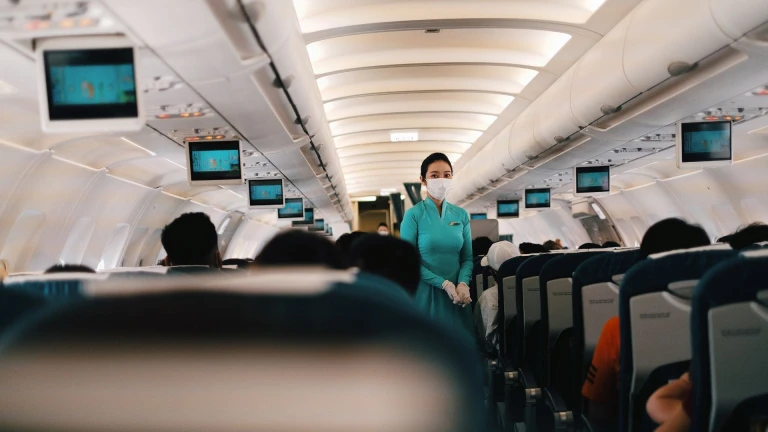
Low-Cost Carriers Are World's Least-Polluting Airlines
As the aviation industry rebounds from the pandemic, environmental concerns take center stage. Low-cost airlines, known for cutting weight to save fuel costs by employing thin seats and eliminating business-class amenities and heavy extras like alcohol and blankets, inadvertently achieve superior emissions metrics. Data from Envest Global reveals that the five airlines emitting the fewest pollutants per passenger are all low-cost carriers, with Hungary-based Wizz Air Holdings leading the pack. In contrast, major carriers such as Delta Air Lines, Cathay Pacific Airways, and British Airways emit nearly double the pollutants per passenger.
This revelation challenges the traditional notion of air travel comfort, as premium seats and spacious cabins contribute significantly to carbon emissions. With the aviation industry facing a 2050 deadline for carbon neutrality, the data implies a need for airlines to pack more passengers into their planes, reduce space, and cut back on amenities to ensure sustainable flying.
Envest Global CEO David Wills emphasizes that the low-cost model aligns with a low-carbon strategy, designed to minimize fuel costs per passenger. Without a significant overhaul, the aviation industry risks missing its mid-century emissions reduction goals. The International Energy Agency warns that the industry is not on track to achieve its net-zero target, with the aviation sector's share of CO2 output expected to rise to 22% by 2050.

Looming Threats
Airlines failing to address emissions may face fines and stricter regulations, as fuel levies are implemented, particularly in Europe. Business and first-class sections, with larger carbon footprints due to their space and weight, come under scrutiny. For instance, a passenger in coach generates 170 kilograms of emissions on a Hong Kong to Singapore flight, while business class on the same route produces 682 kilograms.
Budget carriers have perfected the art of maximizing fuel efficiency, even exploring radical ideas like standing cabins to accommodate more passengers. However, the success of the budget flight movement in driving demand with affordable ticket prices has also led to increased fuel use and CO2 emissions. While focusing on emissions per passenger, it's essential to consider the cargo capacity of full-service carriers.
Challenges Ahead
The challenge ahead is to harness the fuel efficiency of low-cost carriers on a broader scale while managing demand-driven emissions. The International Council on Clean Transportation suggests the need for policies such as a tax on frequent fliers or a carbon price to strike a balance between efficiency measures and potential surges in demand for air travel, especially in premium classes, as seen post-pandemic.
Also Read: Taliban joke to blow up plane gets a British-Indian student to face trial in Spain
Published at
About Author

Manya Shastry
Subscribe our Newsletter
Get our weekly tips and travel news!
Related Posts
Singapore Airlines First Class Cabin Experience: A Luxurious Journey
Singapore Airlines is known for its excellent customer service and luxurious cabin experiences, and its first class cabin is no exception.
What is Air India First Class and Business Class is like?
Air India is the national carrier of India and offers a variety of cabin classes, including First Class and Business Class. These two classes offer passengers a luxurious and comfortable travel experience.
Get Ready for Passport-Free Entry to Dubai and Singapore in 2024
Singapore Changi Airport and Dubai International Airport, two of the world's busiest airports, are set to go passport-free in early 2024, as biometric technology takes over the need for passports.
Hill stations in India that you can take Direct Flights to
Embark on a journey to India's captivating hill stations. In this blog, discover the magic of reaching these elevated retreats with ease through direct flights. From serene landscapes to soaring peaks, explore the beauty of India.
Cheapest Domestic flights on Dec 23rd and Jan 24
Discover vibrant Kolkata, experience Kerala's backwaters, and marvel at the Taj Mahal. With this blog, unlock affordable flights for budget-friendly adventures, whether you're a seasoned traveler or a first-time wanderer.
Latest Posts
Planning a trip? Discover the different types of travel insurance, what they cover, common exclusions and how to decide whether travel insurance is worth it.
Greece's Best-Kept Secrets: 7 Beautiful Places to Visit Beyond Santorini
Beyond Santorini and Mykonos lies a quieter side of Greece. Discover seven beautiful islands filled with hidden coves, whitewashed villages, volcanic landscapes and authentic Greek experiences.
Bangalore’s Top 10 Best Garba Night Venues in 2026
Planning a festive night out? Explore 10 Garba and Dandiya events in Bangalore for Navratri 2026, with venues, dates and helpful booking tips.
Sri Lanka Trip Cost from India in 2026: Budget and 5-Day Itinerary
Planning a Sri Lanka holiday? Explore the estimated 2026 trip cost from India, visa rules, top destinations and a 5-day itinerary.
Best Places to Visit in Goa in December 2026 for Christmas and New Year
Planning a festive getaway? Explore the best places to visit in Goa in December 2026, including Baga Beach, Old Goa, Fontainhas and Palolem for Christmas and New Year.