
Navi Mumbai Airport Opens December 25, 2025: India's Largest Greenfield Airport Takes Off
Mumbai's New Aviation Gateway: Navi Mumbai International Airport Launch Date Confirmed
India's aviation landscape is set for a historic transformation as Navi Mumbai International Airport officially commences commercial operations on December 25, 2025. Following its inauguration by Prime Minister Narendra Modi on October 8, 2025, the airport will make Mumbai the first city in India to operate two international airports simultaneously. This landmark development marks the culmination of nearly three decades of planning, with the project first proposed in 1997.
The new airport, developed by Navi Mumbai International Airport Limited through a public-private partnership between Adani Airport Holdings and the City and Industrial Development Corporation, represents a massive investment estimated at over Rs 19,650 crores. Spread across 1,160 hectares in Panvel, approximately 35 kilometers from Mumbai's existing airport, this greenfield facility promises to revolutionize air connectivity across Maharashtra and beyond.

Airlines Ready for Navi Mumbai Airport Launch
Three major Indian carriers have confirmed their inaugural flights for December 25, creating competitive options for travelers from day one. Akasa Air will operate the first commercial departure with flight QP 1831 to Delhi, scheduled to depart at 5:25 AM on Christmas morning. The airline has already opened bookings and will initially connect Navi Mumbai to Delhi, Goa (Mopa), Kochi, and Ahmedabad, with fares to Delhi starting around Rs 6,000.
IndiGo, India's largest airline, will launch with the inaugural arrival from Bengaluru followed by a departure to Hyderabad. The carrier plans to serve 10 cities from opening day with 18 daily departures, connecting passengers to Delhi, Bengaluru, Hyderabad, Ahmedabad, Lucknow, North Goa, Jaipur, Nagpur, Kochi, and Mangalore. By November 2026, IndiGo aims to scale operations to over 100 flights daily across 16 cities.
Air India Express has announced 20 daily services to 15 domestic destinations initially, with plans to expand to 55 flights, including five international routes, by mid-2026. From January 1, 2026, the airline will operate twice-daily services on key routes like Bengaluru and Delhi.
World-Class Facilities and Smart Technology
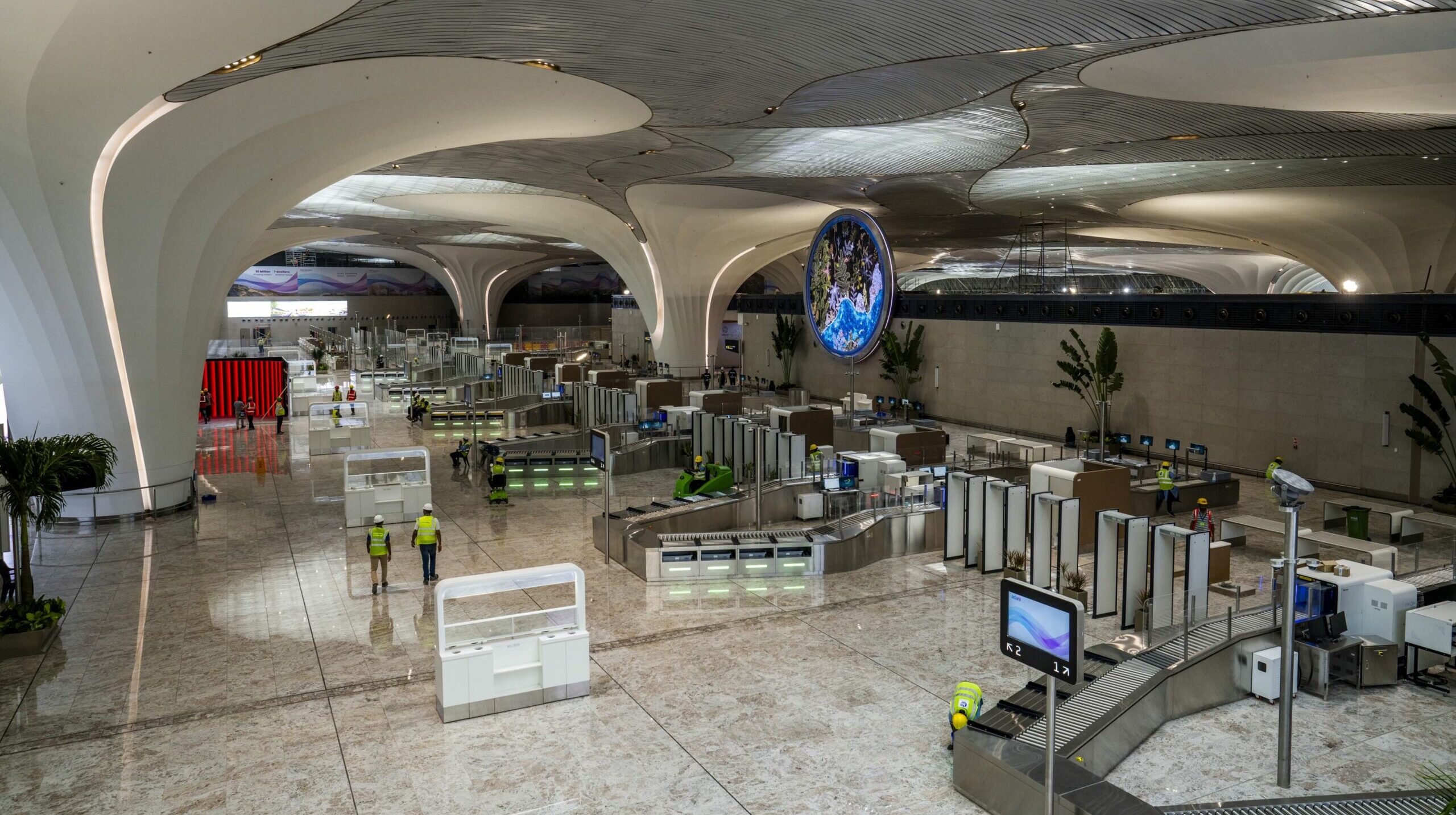
Navi Mumbai International Airport positions itself as India's first fully digital airport, incorporating cutting-edge technology throughout the passenger journey. The facility features facial recognition systems, biometric e-gates, and smart baggage handling that promise to streamline the travel experience significantly. Security infrastructure includes deployment of 900 Central Industrial Security Force personnel in Phase 1, expanding to 1,800 as operations grow.
The terminal building spans a massive area designed to handle 20 million passengers annually in its first phase. Advanced surveillance systems, automated entry checks, and sophisticated passenger screening technologies ensure safety without compromising efficiency. The airport's design prioritizes intuitive wayfinding with a straightforward layout that reduces passenger confusion and transit times.
Beyond passenger amenities, the cargo infrastructure is equally impressive. The domestic cargo terminal covers 33,000 square meters while the international cargo terminal occupies 23,700 square meters, together capable of handling 800,000 tonnes annually. The airport also includes 67 general aviation aircraft stands with a dedicated heliport, catering to private and charter operations that will gradually relocate from Mumbai's main airport.

Sustainability at the Core of Operations
Environmental responsibility forms a cornerstone of Navi Mumbai Airport's design philosophy. The facility boasts a 47-megawatt solar power installation, making it one of India's most sustainable aviation hubs. Comprehensive water management systems include rainwater harvesting and water recycling infrastructure that significantly reduce freshwater consumption.
Electric vehicle-based ground transport minimizes carbon emissions within the airport premises, while smart waste management systems ensure efficient disposal and recycling. The project has also allocated 245 hectares for development as a mangrove park, balancing infrastructure growth with ecological preservation. These green initiatives align with India's broader commitment to sustainable tourism and aviation development.
How Navi Mumbai Airport Eases Regional Congestion
The existing Chhatrapati Shivaji Maharaj International Airport has operated near capacity for years, creating slot constraints that limit airline growth and increase delays. Navi Mumbai Airport provides immediate relief by absorbing new traffic and gradually taking over specific operations. Private and charter aircraft movements will transition entirely to Navi Mumbai by the end of 2025, freeing up valuable slots at the main airport.
Business travelers and residents of Navi Mumbai, Panvel, and Pune will benefit from significantly reduced travel times to reach an airport. The new Mumbai-Pune Expressway link road cuts travel time from Pune by approximately two and a half hours compared to reaching the existing Mumbai airport. With Navi Mumbai's estimated population of 2.6 million in the wider metropolitan area, the airport serves a substantial catchment directly.
Connectivity and Access: How to Reach Navi Mumbai Airport
Multiple road connections ensure convenient access from different parts of the Mumbai Metropolitan Region. The Sion-Panvel Highway provides direct connectivity from central Mumbai, while Palm Beach Road offers an alternative route for travelers from southern suburbs. The National Highway 348 borders the airport's eastern boundary, and Aamra Marg runs along the western side.
For travelers coming from Pune, the new Mumbai-Pune Expressway offers the fastest route, covering approximately 120 kilometers. The airport is located about 46 kilometers from the existing Mumbai airport, making inter-airport transfers feasible though time-consuming. Future plans include metro rail connectivity and enhanced public transport options to improve accessibility further.
Expansion Plans: From 20 Million to 90 Million Passengers
While Phase 1 opens with capacity for 20 million passengers annually, the long-term vision is substantially more ambitious. The phased development plan targets 90 million passengers per year by 2032, positioning Navi Mumbai among India's busiest airports. This expansion will include construction of a second parallel runway, additional terminal buildings, and expanded cargo facilities capable of handling 2.5 million tonnes annually.
A temporary air traffic control tower currently overlooks the single 3,700-meter runway. This structure will serve operations for six to seven years before being replaced by a larger permanent tower positioned near future terminal buildings. The new tower will provide coverage for both planned parallel runways, supporting the airport's projected handling of 80 flights per hour and up to 1,900 flights in 24 hours at full capacity.
Impact on India's Aviation Vision 2040
Navi Mumbai Airport represents a crucial component of India's Aviation Vision 2040, which aims to establish 200 functional airports nationwide and accommodate 1.1 billion air passengers annually. The Ministry of Civil Aviation's ambitious roadmap includes 50 new airports within the next five years, with Delhi and Mumbai each planned to have three international airports.
The successful launch of Navi Mumbai Airport demonstrates India's capability to execute complex infrastructure projects despite challenges like land acquisition and environmental clearances. Tourism Minister Gajendra Singh Shekhawat has emphasized that infrastructure development, including aviation facilities, is essential for achieving the government's target of a trillion-dollar tourism sector by 2047.
What This Means for Travelers and Tourism
For passengers, Navi Mumbai Airport offers more flight options, competitive pricing through increased airline competition, and modern facilities that enhance the travel experience. Holiday travelers during peak seasons like Diwali and Christmas will benefit from reduced congestion compared to the existing airport. Business travelers gain access to efficient facilities with strong connectivity to India's major commercial centers.
Tourism across Maharashtra and Western India stands to gain significantly. Improved connectivity makes destinations like Lonavala, Mahabaleshwar, Alibaug, and the Konkan coast more accessible to both domestic and international visitors. The airport's capacity for international flights will eventually strengthen Mumbai's position as a gateway to India for foreign tourists.
Challenges and Considerations for Early Travelers
Initial operations may experience growing pains as airlines, passengers, and ground services adjust to the new facility. Travelers should allow extra time for their first visits while familiarizing themselves with the airport layout and access routes. Some amenities and retail options may be limited initially compared to Mumbai's established airport.
The geographic distance between the two Mumbai airports creates challenges for connecting passengers, especially with tight layovers. Airlines will need to carefully coordinate schedules to ensure smooth transfers between airports. Travelers should verify which Mumbai airport their flights depart from to avoid confusion, particularly when booking travel packages or making separate flight arrangements.
Comparison with Delhi's Noida Airport Plans
While Mumbai achieves its two-airport milestone this December, Delhi's second airport at Noida-Jewar is in final stages of completion with an opening expected in early 2026. The competition between India's two largest cities to establish dual-airport systems highlights the intense demand for air travel infrastructure. Noida International Airport, planned with six runways and capacity for 70 million passengers annually, will eventually surpass Navi Mumbai in scale.
Both projects, however, share common goals of relieving congestion at overcrowded primary airports, spurring economic development in surrounding regions, and positioning India as a global aviation powerhouse. The near-simultaneous opening of these mega-airports marks a defining moment in India's aviation evolution.
FAQ
When does Navi Mumbai Airport start operations?
Navi Mumbai International Airport commences commercial flights on December 25, 2025. The airport was inaugurated by Prime Minister Narendra Modi on October 8, 2025, with airlines beginning passenger services on Christmas Day.
Which airlines will fly from Navi Mumbai Airport?
Akasa Air, IndiGo, and Air India Express will operate from opening day. Akasa Air launches flights to Delhi, Goa, Kochi, and Ahmedabad. IndiGo connects 10 cities including Delhi, Bengaluru, and Hyderabad. Air India Express offers 20 daily services to 15 domestic destinations initially.
How do I reach Navi Mumbai Airport from Mumbai?
Access the airport via Sion-Panvel Highway, Palm Beach Road, or National Highway 348. The airport is located in Panvel, approximately 46 kilometers from Mumbai's existing airport and about 35 kilometers from central Mumbai.
What is the passenger capacity of Navi Mumbai Airport?
Phase 1 handles 20 million passengers annually. The airport is designed to expand to 90 million passengers per year by 2032 through phased development including a second runway and additional terminals.
Can I book flights to Navi Mumbai Airport now?
Yes, flight bookings are open through airline websites and mobile apps. Akasa Air, IndiGo, and Air India Express are accepting reservations for flights beginning December 25, 2025.
What makes Navi Mumbai Airport different from other Indian airports?
It is India's first fully digital airport featuring facial recognition, biometric e-gates, and smart baggage systems. The airport also incorporates extensive sustainability measures including 47 MW solar power, EV-based transport, and advanced water conservation systems.
Closing Remarks
The opening of Navi Mumbai International Airport on December 25, 2025, represents a transformative milestone for Indian aviation and tourism. As Mumbai becomes the first Indian city with two operational international airports, travelers gain access to world-class facilities, enhanced connectivity, and a glimpse of India's aviation future. With three major airlines ready to launch services from day one and ambitious expansion plans through 2032, Navi Mumbai Airport promises to reshape travel patterns across Western India while supporting the nation's journey toward becoming a trillion-dollar tourism economy. Whether you're a frequent business traveler or planning your next holiday, this state-of-the-art airport offers compelling reasons to experience India's newest aviation gateway.
Travel Tip: Book early for flights from Navi Mumbai Airport during the initial months, as airlines are gradually scaling up capacity and popular routes may fill quickly during the festive and holiday season.
Published at

Subscribe our Newsletter
Get our weekly tips and travel news!
Related Posts
West Bengal: Tagore's Residence Santiniketan Achieves UNESCO World Heritage Status
Santiniketan, a town in West Bengal's Birbhum region where Nobel laureate Rabindranath Tagore spent much of his life, has been added to the UNESCO World Heritage List.
UK Visitor Visa Fee Hiked: What's the New fee?
Planning to visit the United Kingdoms? Watchout for this Hike in Visa Charges. A UK tourist visa for less than six months will cost an additional £1,543 (£ 15), while UK student visas will cost an additional £13,070 (£127) for visitors from all over the w
India Issues Caution for Travel to Canada - Visa suspended
The advisory, issued by the Ministry of External Affairs (MEA), comes amid a diplomatic row between the two countries over allegations that the Indian government may be linked to the extra-judicial killing of a Sikh separatist in Canada.
First snowfall of the season in Gulmarg
As the chilly winds of winter start to sweep across the northern regions of India, Gulmarg, the crown jewel of Jammu and Kashmir, has once again transformed into a breathtaking winter wonderland. Nature's magic was on full display as Gulmarg recently...
Biswanath Ghat: Best tourism village of India 2023
In an exciting announcement, Biswanath Ghat in Assam has been crowned as India's "Best Tourism Village of 2023" by the Ministry of Tourism. This well-deserved recognition is a testament to the village's unique blend of cultural heritage, natural beau...
Latest Posts
Best New Year 2027 Destinations in India by Budget
Looking for a New Year getaway? Explore 10 destinations in India for welcoming 2027, with estimated budgets, things to do and tips for planning an affordable holiday.
Things to Do in Burkina Faso: Food, Culture and Unique Travel Experiences
Explore Burkina Faso's rich cultural heritage through traditional dishes, vibrant music, handmade textiles, major festivals and fascinating historic landscapes.
Madame Tussauds Singapore Launches Icons of India Diwali Campaign
Madame Tussauds Singapore and MakeMyTrip celebrate Diwali with the Icons of India campaign, featuring Bollywood wax figures and a special Buy One Get One ticket offer.
Best Time to Visit Mexico: Festivals, Hidden Gems & Travel Tips
Discover the best time to visit Mexico, from sunny Caribbean beaches and hidden colonial towns to vibrant festivals like Día de los Muertos and Oaxaca’s Guelaguetza. Explore seasonal travel tips, offbeat destinations, local food experiences and the best m
Best Places to Visit in India During Diwali Holidays 2026
Planning a Diwali holiday in 2026? Explore eight destinations across India, including Ayodhya, Jaipur, Amritsar, Goa and Varanasi, for a memorable festive getaway.