
Dark Sky Tourism in India: 7 Best Places for Stargazing
What if your next holiday didn't involve crowded cafes, packed sightseeing schedules or waking up at 5 AM to catch a sunrise? What if the biggest attraction was simply looking up?
Imagine lying on a quiet hillside, wrapped in a blanket, with no city lights, no traffic and no notifications demanding your attention. Above you, thousands of stars stretch across the sky, the Milky Way looks like a glowing river and, for once, you find yourself wondering just how small we really are.
Sounds like something out of a movie? Welcome to the world of Dark Sky Tourism.
While most holidays are planned around beaches, mountains, food trails and adventure activities, a new kind of travel experience is encouraging people to explore something much farther away: the universe itself.
And the best part? India has some spectacular places where you can experience it.
What Exactly Is Dark Sky Tourism?
Dark Sky Tourism, also known as astrotourism, is a form of travel centred around experiencing the night sky. Instead of visiting a destination for its shopping streets or famous monuments, travellers visit places with minimal artificial lighting to observe stars, planets, meteor showers and even distant galaxies.
Think stargazing in the middle of a desert, photographing the Milky Way from a Himalayan village or watching Saturn's rings through a telescope.
The idea is also closely connected to the growing concern around light pollution. Bright streetlights, illuminated buildings, billboards and urban development have made it increasingly difficult to see stars from major cities.
For someone living in a metropolitan city, spotting more than a handful of stars can feel like an achievement. Dark Sky Tourism offers an opportunity to experience what the night sky looks like without all that artificial interference.
And no, you don't need to own a telescope or have a degree in astronomy to enjoy it. A clear night, a dark location and a little curiosity are often enough.
7 Best Places in India for Dark Sky Tourism
India's geographical diversity offers some wonderful opportunities for stargazing, from high-altitude Himalayan deserts to open salt plains and quiet forest landscapes.
Here are seven destinations worth adding to your travel bucket list.
1. Hanle, Ladakh - India's First Dark Sky Reserve
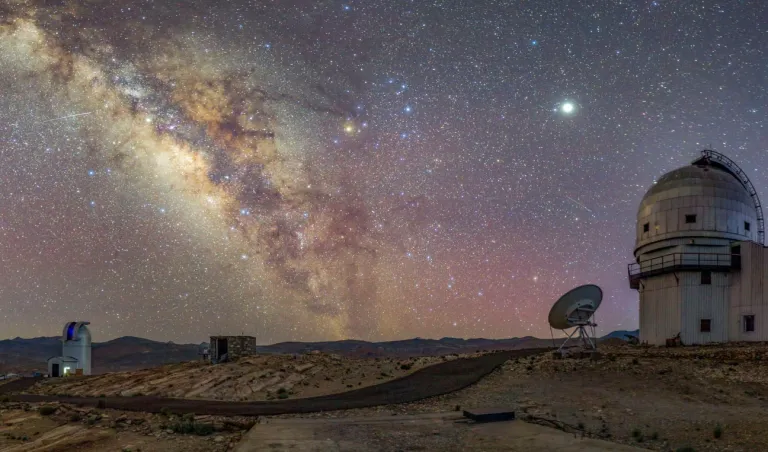
If there is one destination that deserves to be at the top of every stargazing enthusiast's list, it is Hanle.
Located in the Changthang region of Ladakh, Hanle is home to India's first officially designated Dark Sky Reserve, established in December 2022.
Far away from major urban settlements, the village enjoys exceptionally dark skies, making it an important destination for both professional astronomers and curious travellers.
On a clear, moonless night, the Milky Way can appear so vividly that you might spend more time looking upwards than at the spectacular mountains around you.
Hanle is also home to the Indian Astronomical Observatory, operated by the Indian Institute of Astrophysics.
What makes the experience particularly special is its community-led approach to astrotourism. Local residents have been trained as Astronomy Ambassadors, helping visitors explore the night sky using telescopes.
Things to experience:
Stargazing sessions with local Astronomy Ambassadors.
Milky Way photography.
Exploring the Indian Astronomical Observatory, subject to visitor permissions.
Experiencing the peaceful landscapes of Changthang.
Best time to visit: April to October, with clear, moonless nights offering better stargazing opportunities. Always check road and weather conditions before travelling.
Travel tip: Hanle sits at a very high altitude, so acclimatise properly in Leh before travelling further. Don't rush the journey just to catch a night-sky view.
2. Spiti Valley, Himachal Pradesh - A Himalayan Sky Full of Stars
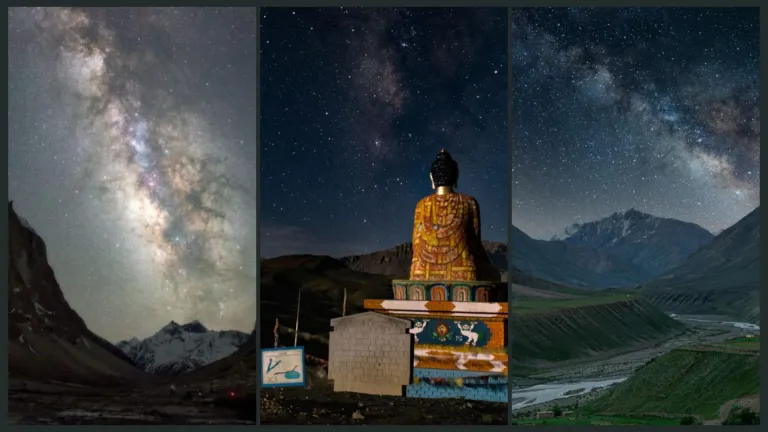
Spiti is already famous for its dramatic mountains, ancient monasteries and remote villages. But when the sun disappears behind its rugged peaks, another attraction takes over.
The valley's high altitude, dry climate and relatively low levels of artificial lighting create excellent conditions for stargazing.
Villages such as Langza, Komic and the outskirts of Kaza offer wonderful settings for spending an evening beneath the stars.
Imagine sitting outside a traditional homestay, sipping a hot cup of tea while the Milky Way slowly becomes visible above the mountains. It is the kind of experience that makes you forget about checking your phone every five minutes.
Things to experience:
Stargazing and astrophotography around Langza.
Spending a night in a traditional Spitian homestay.
Exploring Key Monastery and nearby villages during the day.
Photographing star trails against the Himalayan landscape.
Best time to visit: May to October, depending on road accessibility and weather.
Travel tip: Choose accommodation away from bright village lights. Also, carry warm clothing because temperatures can drop considerably after sunset, even during summer.
3. Rann of Kutch, Gujarat - Stars Above the White Desert
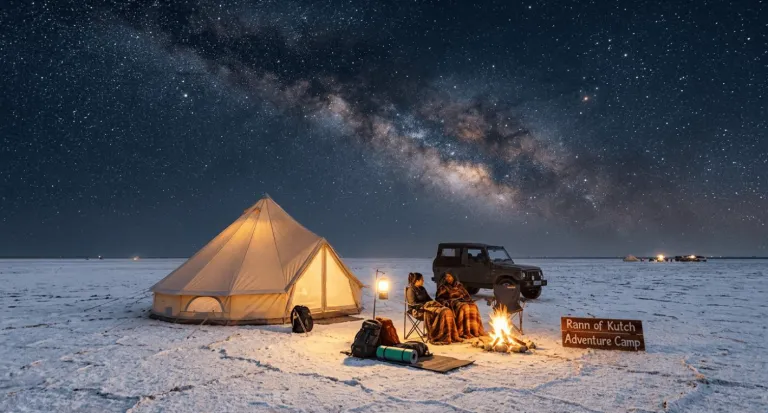
The Rann of Kutch is one of those destinations that feels almost unreal.
During the day, the enormous white salt desert stretches towards the horizon. At night, when the crowds thin out and artificial lighting becomes scarce, the landscape transforms into a wonderful setting for observing the stars.
The open terrain offers wide horizons, making it particularly interesting for night-sky photography.
If you are visiting during the Rann Utsav season, you can combine the experience with traditional Gujarati food, cultural performances, local handicrafts and desert camping.
However, for a proper stargazing experience, try to get away from brightly illuminated festival areas.
Things to experience:
Stargazing in quieter sections of the White Rann.
Desert photography under the night sky.
Exploring local handicraft villages.
Experiencing the cultural celebrations of Rann Utsav.
Best time to visit: November to February, when the weather is relatively pleasant.
Travel tip: Plan your visit around a new moon and check local access restrictions. The White Rann is a regulated area, so obtain the required permits.
4. Jaisalmer, Rajasthan - A Night in the Thar Desert
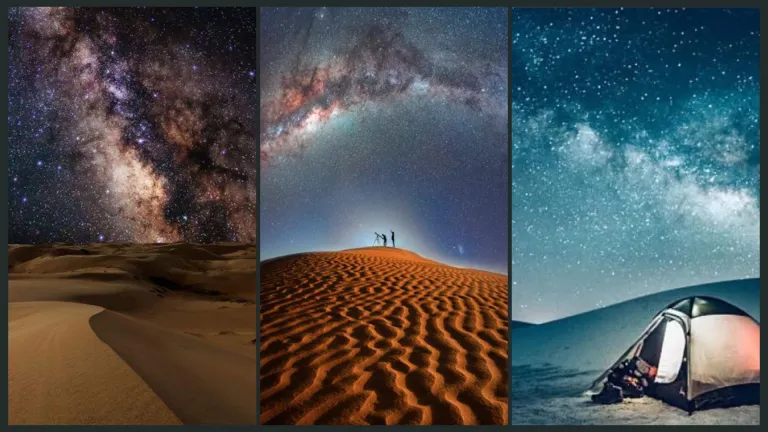
Jaisalmer is usually associated with golden forts, havelis, desert safaris and luxurious camps. But there is another side to the Thar Desert that deserves attention.
Away from the illuminated tourist camps and busy settlements, the desert offers wide-open landscapes and beautiful opportunities for stargazing.
The absence of tall buildings and the expansive horizon make it a lovely place to observe constellations and photograph star trails.
You can spend the afternoon exploring the old city, enjoy a camel safari around sunset and finish the day sitting outside a desert camp under the night sky.
Things to experience:
Stargazing away from the main tourist camps.
Desert camping and traditional Rajasthani dinners.
Photographing the night sky against sand dunes.
Exploring Jaisalmer Fort and nearby heritage villages.
Best time to visit: October to March.
Travel tip: Choose a desert camp with limited outdoor lighting and avoid heavily illuminated entertainment areas if stargazing is your priority.
5. Coorg, Karnataka - A Stargazing Escape in the Western Ghats
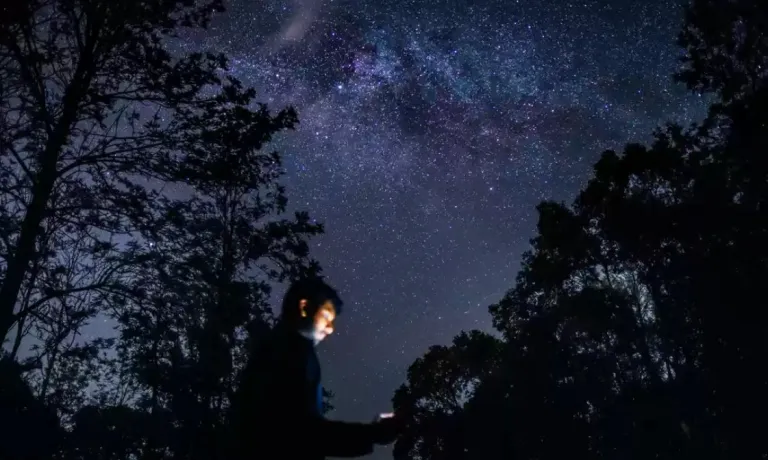
You don't always have to travel to the Himalayas to enjoy a beautiful night sky.
Coorg, with its coffee plantations, rolling hills and quieter countryside, offers an interesting escape for travellers from Bengaluru and other South Indian cities.
While its skies are not as dark as Hanle or Spiti, certain rural locations away from towns and artificial lighting can offer rewarding stargazing experiences.
Imagine spending the day walking through coffee estates, enjoying local Kodava cuisine and ending the evening around a quiet property with a view of the stars.
Things to experience:
Stargazing from secluded plantation stays.
Night-sky photography on clear evenings.
Exploring coffee estates and local villages.
Combining a relaxing nature holiday with astronomy experiences.
Best time to visit: October to March, when clearer skies are generally more favourable.
Travel tip: Pick accommodation away from major towns and check the weather before planning a dedicated stargazing evening. Cloud cover can change the experience completely.
6. Kodaikanal, Tamil Nadu - A Quiet Escape Above the Clouds
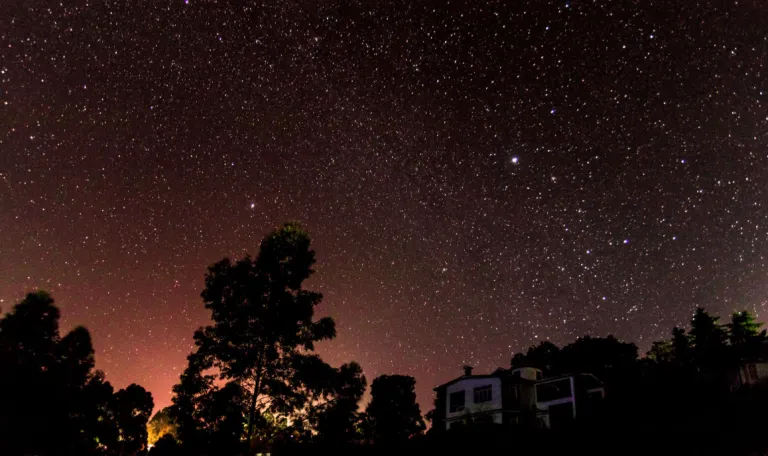
Kodaikanal is often associated with misty mornings, lakes, pine forests and romantic viewpoints. But the hill station also has an interesting connection with astronomy.
The Kodaikanal Solar Observatory, established in 1899, has played an important role in solar research in India.
For travellers, the surrounding hill landscapes offer opportunities to enjoy the night sky when weather and local lighting conditions cooperate.
Unlike extremely remote destinations, Kodaikanal also offers plenty of accommodation and other activities, making it suitable for travellers who want to combine a regular hill holiday with a little astronomy.
Things to experience:
Learning about the history of astronomy at the Kodaikanal Solar Observatory, subject to visitor access.
Exploring quieter viewpoints and countryside locations.
Night-sky photography on clear evenings.
Enjoying forest walks and lakeside experiences during the day.
Best time to visit: October to February generally offers more favourable conditions, although cloud cover can vary.
Travel tip: Avoid planning your entire trip around one night of stargazing. Keep alternative sightseeing plans in case the weather does not cooperate.
7. Pangong Lake, Ladakh - When the Mountains Meet the Milky Way
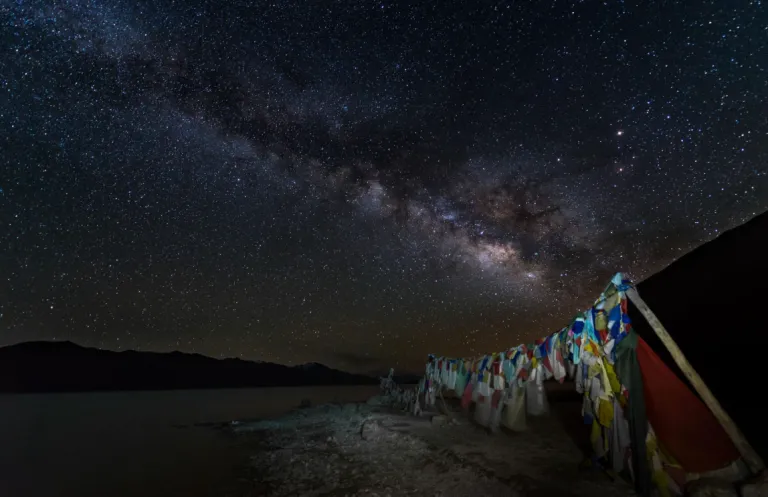
Pangong Lake is breathtaking during the day, but imagine seeing it under a sky filled with stars.
Located at a high altitude, the lake's remote surroundings and limited artificial lighting make it an appealing location for night-sky photography.
On suitable nights, the combination of mountain silhouettes, the lake and the stars creates a spectacular setting for photographers.
If you are lucky with the weather and the moon phase, you might even capture the Milky Way stretching above the landscape.
Things to experience:
Night-sky photography around the lake.
Stargazing from permitted accommodation areas.
Exploring the lake's changing colours during daylight.
Combining the visit with other Ladakh destinations.
Best time to visit: May to September, subject to road and weather conditions.
Travel tip: Pangong is at a high altitude. Acclimatise properly and follow local accommodation, environmental and travel regulations.
When Is the Best Time to Go Stargazing in India?
There is one important thing to understand before planning a dark-sky holiday: even the darkest destination cannot guarantee a spectacular night if the sky is cloudy or the moon is too bright.
For the best experience, consider three things:
1. The moon phase
New moon nights are generally ideal because there is very little moonlight competing with the stars. A bright full moon can wash out fainter stars and make Milky Way photography difficult.
2. Weather conditions
Clear skies are essential. Check cloud cover, rainfall and local weather forecasts before your trip.
3. Seasonal visibility
Different celestial objects are visible at different times of the year. The Milky Way's bright central region, for instance, has seasonal viewing windows that depend on your location.
A quick destination guide:
Destination | Generally favourable months |
Hanle, Ladakh | April-October |
Spiti Valley | May-October |
Rann of Kutch | November-February |
Jaisalmer | October-March |
Coorg | October-March |
Kodaikanal | October-February |
Pangong Lake | May-September |
These are broad travel windows, not guarantees of clear skies. Always check local conditions and moon phases before booking.
What Should You Carry for a Dark Sky Holiday?
You don't need to arrive with expensive astronomical equipment. In fact, your first stargazing trip can be surprisingly simple.
Here are a few essentials:
Warm clothing: Nights can get extremely cold, especially in high-altitude destinations.
A red-light torch: It helps you move around without ruining your night vision.
Binoculars: A beginner-friendly way to explore the Moon, star clusters and other celestial objects.
A camera and tripod: Useful if you want to try night-sky photography.
Power bank: Cold weather can drain batteries faster.
Offline maps: Remote destinations may have limited network connectivity.
A moon-phase calendar: Helps you plan your trip around darker nights.
And remember, you don't need to know the names of every constellation to enjoy the experience. Sometimes simply lying back and looking at the sky is enough.
How to Photograph the Milky Way: A Few Beginner Tips
If you have ever seen photographs of the Milky Way on Instagram and wondered how people capture such incredible skies, you don't necessarily need professional equipment.
Start with these basics:
Choose a location away from artificial lights.
Use a tripod to keep your camera steady.
Switch to manual mode and use a wide aperture.
Experiment with longer exposure times and higher ISO settings.
Focus manually on a bright star.
Take multiple photographs and experiment with your settings.
If you are using a smartphone, look for its dedicated night mode or astrophotography mode, if available.
One important thing: avoid using your phone's flash when everyone is trying to observe the sky. Nobody wants their carefully adjusted night vision ruined by a sudden burst of light!
Why Dark Sky Tourism Is More Than Just Stargazing
There is something particularly interesting about this form of travel. It encourages people to appreciate something that has been around for billions of years but is becoming increasingly difficult to see.
Light pollution does not only affect astronomy. Excessive artificial lighting can also disturb nocturnal wildlife, affect natural ecosystems and waste energy.
India's Hanle Dark Sky Reserve demonstrates how tourism can support conservation while creating opportunities for local communities.
The initiative involves local residents as astronomy guides and promotes responsible lighting practices to protect the region's dark skies. This means visitors aren't simply coming to observe the universe; they are also contributing to a tourism model that values the environment and local livelihoods.
Perhaps that is what makes dark-sky destinations so special. The experience is not about ticking off another attraction. It is about understanding why places like these need to be protected.
Final Thoughts: Perhaps Your Next Holiday Should Be Written in the Stars
We spend so much time planning holidays around what we can see, eat, buy and photograph. But sometimes, the most memorable travel experiences come from doing very little.
No crowded attractions, no endless queues and no rush to reach the next viewpoint.
Just a quiet night, a blanket, a few curious travellers and a sky full of stars.
Whether you choose the remote landscapes of Hanle, the mountains of Spiti or the open deserts of Rajasthan, dark sky tourism offers a refreshing way to experience India.
And who knows? You might return from your next holiday with fewer shopping bags, hundreds of photographs and a newfound interest in astronomy.
Not a bad trade for a few nights under the stars.
Published at
About Author

Atihsin
Subscribe our Newsletter
Get our weekly tips and travel news!
Related Posts
The only Backpacking Guide for India that you'll ever need
Embark on a soulful backpacking adventure across India! This guide ensures a memorable journey, creating lifelong memories and a deep appreciation for the extraordinary. Enjoy every moment of exploration. Safe travels!
10 Backpacking Destinations in India that you must check out in 2024
In 2024, explore India's diverse beauty with these 10 must-visit backpacking destinations, offering mountains, beaches, and cultural gems for every traveler.
10 Amazing Backpacking Destinations to Add to Your List in 2024
From spiritual havens to nomadic adventures, explore a tapestry of cultures and landscapes, promising an unforgettable journey.
Back Packing Checklist for India - Things you need for Backpacking in 2024
Gear up for your epic Indian backpacking adventure! This guide outlines essentials like clothes, travel docs, tech, and embrace the "Jugaad". Pack light, stay open-minded, and prepare for chai spills and unforgettable memories!
Bengaluru tops the "Most livable cities in India 2024" List
According to the data released by Ease of Living Index, Bengaluru has earned the prestigious title of the most livable city in India in 2024!
Latest Posts
10 Best Shopping Places in Dubai for Tourists in 2026
Planning a shopping trip to Dubai? Explore 10 popular shopping destinations, from luxury malls and designer outlets to traditional souks, gold markets and affordable shopping areas.
Supreme Court on 700% Airfare Hike: New Rules Explained
The Supreme Court has refused an urgent hearing on a plea alleging a 700% rise in domestic airfares during Diwali. With new aviation rules coming into effect in January 2027, here's what passengers need to know.
5 Offbeat Places to Spend Your New Year in India: Escape the Crowds and Welcome 2027 Differently
Tired of crowded New Year destinations? Explore five offbeat Indian getaways featuring riverside bonfires, desert adventures, cultural escapes and peaceful mountain retreats.
4 Best Beach Treks in India for Adventure Lovers
Who said trekking was only about mountains? Discover four incredible beach treks in India featuring hidden coves, dramatic cliffs, beautiful coastlines and unforgettable seaside adventures.
Best International Christmas Destinations from India in 2026
Planning a Christmas holiday abroad in 2026? Explore the best international destinations from India, from snowy European cities and festive Christmas markets to tropical beaches and budget-friendly getaways.